
Renting a car in Osaka lets you explore one of Japan’s liveliest cities more freely and easily! With its rich culture, great food and countless attractions, Osaka draws visitors from all over. To get around the city with ease, a rental car is a flexible and convenient option.
| Do you need to rent a car in Osaka? Is self-drive travel in Osaka convenient?
A rental car gives you far more flexibility and freedom: you can easily head out to the areas around Osaka and visit more attractions without being limited by subway lines. Of course, if you only plan to stay within central Osaka, the JR and municipal subway are more than enough!
In certain situations, renting a car can also be more economical. If you’re traveling with family or friends, splitting the rental cost may work out cheaper than buying multiple subway tickets. A car also saves time getting from your hotel to each attraction, especially when your itinerary is packed.
This article walks you through the advantages of renting a car in Osaka, plus everything you need to know about driving in the city.
What to bring to rent a car in Osaka
Before you plan an Osaka car rental, make sure your documents are in order. Here are the important points to note:

1. Passport
Make sure your passport is valid for the whole rental period and that the details on it match the information you gave when booking.
2. Valid driver’s license & Japanese translation
If you plan to rent a car or motorcycle in Osaka, make sure your driver’s license, or its Japanese translation, is still valid in your home country.
Tip | We recommend bringing the original of your home-country driver’s license so you can show it if needed.

For travelers from Taiwan, Belgium, Switzerland, France, Germany, Monaco, Estonia and Slovakia, Japan only accepts a “Japanese translation of your home-country driver’s license” from these countries.

Bring your passport, your home-country driver’s license and the Japanese translation of your license in order to legally rent a car or motorcycle.
(In Taiwan you can apply at any Motor Vehicles Office for NT$100; if your license is an older version or has expired, a reissue or renewal costs NT$200.)
Tip | The Japanese translation must match the details on your license, so if your license is reissued or renewed, be sure the information is consistent.
3. Valid driver’s license & International Driving Permit
If you hold an International Driving Permit (IDP) issued by a country party to the 1949 Geneva Convention on Road Traffic (valid for one year), you can drive or rent a car or motorcycle legally in Japan with your passport and IDP.
Tip | Japan does not recognize International Driving Permits issued by countries party to the 1926 Paris Convention, the 1943 Washington Convention or the 1968 Vienna Convention.
Under Japanese rules, as long as you hold the valid documents above, you may drive or rent a car or motorcycle within one year of entering Japan.

4. Credit card
Some rental companies pre-authorize a deposit on a credit card, which means that at pickup they will check either the “credit card details of the person who made the booking” or the “credit card details of the renter who will be driving“.
So before you set off, make sure you bring the relevant credit card to the rental branch so your booking goes through smoothly. This is an important step that helps you avoid unnecessary hassle and delays.
Osaka car rental companies
Osaka has plenty of chain rental companies, including well-known names such as TOYOTA Rent a Car, ORIX RENT-A-CAR, Budget Rent a Car and Times CAR RENTAL. Each offers different vehicle deals and add-on services. The table below compares some of these companies with gogoout:
| gogoout | Budget Rent a Car | TOYOTA Rent a Car | ORIX RENT-A-CAR | |
|---|---|---|---|---|
| Airport/station pickup service | ✕ | ✕ | Pickup can be booked at some stations | ✕ |
| Chinese-language support | ○ (live Chinese-language support) | ○ (Chinese-language chatbot) | ✕ | ✕ |
| GPS | ○ (depends on the branch’s options) | ○ (standard equipment) | ○ (standard equipment) | ○ (standard equipment) |
| ETC | ○ (depends on the branch’s options) | ○ (paid add-on) | ○ (paid add-on) | ○ (paid add-on) |
| Child seat | ○ (depends on the branch’s options) | ○ (paid add-on) | (depends on whether the branch offers it) | ○ (paid add-on) |
| Opening hours | 8:00~20:00 (hours vary by branch) |
8:00~20:00 | 8:00~20:00 | 08:30~19:30 |
Types of car rental insurance in Osaka

When renting a car in Osaka, talking about the compensation system really means talking about the rental insurance rules.
Japan has a basic insurance system for vehicles on the road, such as compulsory liability insurance, which provides a certain level of coverage (for personal injury, property damage, damage to the vehicle and so on). This basic fee is usually already included in the rental price. Although most of the compensation is paid by the insurer, some costs still have to be covered by the renter, and that is the so-called “deductible”.
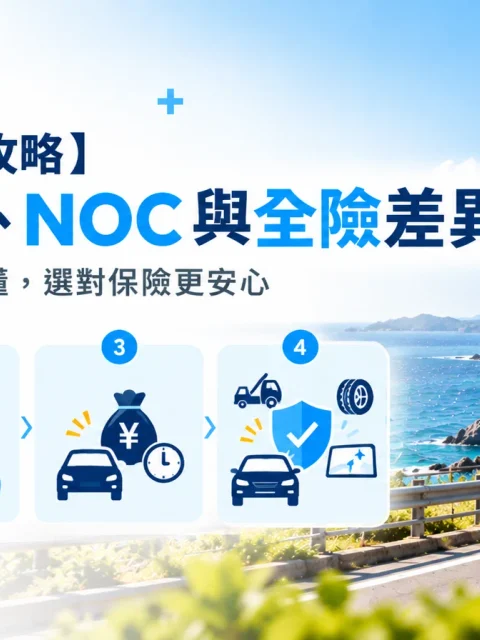
Within this deductible coverage, there are two different waiver schemes:
1. Collision damage waiver (CDW)
(Collision Damage Waiver): a damage waiver that is usually used to reduce the renter’s financial burden if the vehicle is damaged or involved in a collision. On top of the basic compulsory insurance, it waives the deductible you would otherwise pay for that incident.
2. NOC coverage (non-operation charge)
(Non-Operation Charge): this covers the rental company’s lost business, the same idea as the loss-of-use fee commonly seen in Taiwan. Some rental companies offer this option, which waives the loss-of-business fee the branch incurs while the vehicle is being repaired after the incident.
Tip | These two insurance options are separate, so one does not automatically cover the loss-of-business fee as well.
| Basic compulsory insurance | + CDW collision damage waiver | + NOC coverage | |
|---|---|---|---|
| Personal injury compensation (to the injured party) | ✔️ | ✔️ | ✔️ |
| Property damage compensation | ✔️ | ✔️ | ✔️ |
| Vehicle damage compensation | ✔️ | ✔️ | ✔️ |
| Personal injury compensation (for passengers) | ✔️ | ✔️ | ✔️ |
| Deductible waiver | ✔️ | ||
| Non-operation charge waiver | ✔️ |
We sincerely recommend that you consider buying the insurance options mentioned above when you book or pick up your car. Accidents can happen at any time, and paying a little extra for insurance can greatly reduce the huge losses that an unfortunate accident may cause. Don’t risk a big loss to save a little money — protecting your own and others’ safety and interests always comes first!
Osaka car rental price comparison
Now that we’ve covered basic car-model prices and insurance, here are price tables for the various add-on options:
| gogoout | Budget Rent a Car | TOYOTA Rent a Car | ORIX RENT-A-CAR | |
|---|---|---|---|---|
| Car price (per day / add-ons not included) | From NT$1,690 | About NT$1,670 | About NT$1,990 | About NT$2,035 |
| GPS | Depends on the provider | Free | Free | Free |
| ETC | Depends on the provider | One-time rental fee of ¥330 | One-time rental fee of ¥330 | One-time rental fee of ¥330 |
| Child safety seat | NT$100 / seat | ¥1,100 / seat | ¥550 / 72 hours | ¥1,100 / seat |
| Compulsory insurance | Included in the car price | Included in the car price | Included in the car price | Included in the car price |
| CDW insurance | Added at the counter | ¥1,430 / day | ¥1,100 / 24 hours | ¥1,100 / 24 hours |
| NOC coverage | Added at the counter | ¥2,200 / day | ¥550 / 24 hours | ¥660 / 24 hours |
How to rent a car in Osaka with gogoout
Renting a car in Osaka with gogoout takes just three simple steps. Confirm your rental location and pick-up and drop-off times, choose your car, fill in your basic details and pay — your booking is complete!

Things to know when renting a car in Osaka
1. Traffic rules / traffic fines

Driving on the left in a right-hand-drive car:
Japan drives on the left with the steering wheel on the right, an important difference to watch out for, since it’s the opposite of Taiwan and most Western countries. The steering position and the road rules are reversed from what you’re used to, so don’t panic when you switch on the wipers instead of the turn signal. The key is to drive slowly, pay attention to road conditions and make sure you follow local traffic rules without overlooking any important safety details.
Watch out when turning:
Remember this rule of thumb: “Wide turns to the right, tight turns to the left.”
Also, when approaching an intersection or an exit, check for vehicles on your right first and then look left, to avoid colliding with oncoming traffic.

Safe driving:
Drive steadily, don’t speed, absolutely never drink and drive, and buckle up.
These are basic traffic safety principles in any country. Whether you’re in Taiwan or Japan, follow them strictly.
Speeding fines:
Ordinary roads / expressways, up to 15 km/h over the limit: fine of ¥9,000
Expressways, 30 km/h or more but under 35 km/h over the limit: fine of ¥25,000
Expressways, 35 km/h or more but under 40 km/h over the limit: fine of ¥35,000
Expressways, 40 km/h or more over the limit: fine of ¥100,000
(These are the fines for ordinary small passenger cars; fines differ by vehicle type.)
Drunk driving fines:
Breath alcohol reading of 0.15 mg/l or below: fine of ¥500,000 or more / passengers are also fined ¥300,000 or more
Too intoxicated to drive normally: fine of ¥1,000,000 or more / passengers are also fined ¥500,000 or more
(Not wearing a seat belt won’t get you fined, but if you aren’t wearing one when an accident happens, some insurance coverage may not pay out.)
Using your phone while driving:
Using a phone while driving is strictly prohibited — both taking calls and scrolling are banned by law. Illegal phone use carries a fine of ¥6,000
Yellow lane lines:
Where there is a yellow lane line, note that you may not cross it to overtake unless a sign clearly permits it.
You may, however, turn left, turn right or make a U-turn as long as there is no sign prohibiting it. Always follow the traffic signs and markings so that your driving stays safe and legal.

White lane lines:
Solid white line: you may not cross it to change lanes at will, but it is fine to drive over it to go around a car parked at the roadside — just return to your lane as soon as possible.
Dashed white line: you may change lanes or overtake when it is safe.
Solid yellow line alongside a dashed white line: vehicles on the white-line side may change lanes across to the yellow-line side, but vehicles on the yellow-line side may not change lanes.

Stop and proceed:
The stop-and-proceed rules work differently from Taiwan. When you see the signs “止まれ” (stop) and “踏切” (railroad crossing), you must bring the car to a complete stop and only move off again once you are sure it is safe. Failing to do so brings two possible penalties:
Fine for failing to stop: if you do not come to a complete stop at a “止まれ” sign before proceeding, you face a fine of ¥7,000.
Fine for not stopping at a railroad crossing: failing to stop completely before a railroad crossing can cost you as much as ¥9,000.

Temporary stopping:
In Japan, stopping or parking wherever you like is enforced and punished very strictly. Never count on getting away with it — the penalties are heavy, and this is one bad habit from Taiwan you need to be especially careful about in Japan. So when you need to stop, the best advice is to look for a nearby parking lot; that is always the safest option.
If you really must stop at the side of the road, pay close attention to the markings along the sidewalk curb:
Dashed yellow line: temporary stopping is allowed, but you may not park — the vehicle must stay ready to move.
Solid yellow line: stopping or parking is completely prohibited. Stopping here counts as a serious violation.
Illegal parking can lead to fines, starting from ¥10,000.

Tip | Before pulling into a parking lot, check carefully that it is not a 「月極駐車場」 (monthly-contract parking lot). These are rented by the month rather than charged by the hour, so you could end up in a local resident’s space and have your rental car immobilized!

Clear right of way:
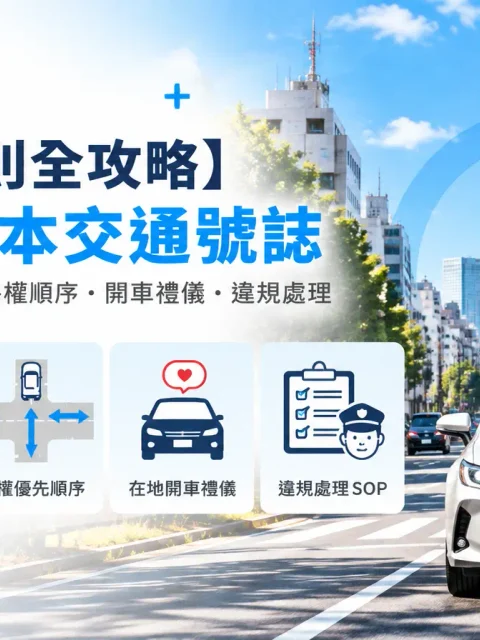
Japan’s traffic rules make right of way very clear, and the usual order of priority is as follows:
Vehicles going straight: they have absolute priority, meaning they go through the intersection first and other vehicles must wait for them.
Left-turning vehicles: they generally come before right-turning vehicles but after vehicles going straight. In other words, a left-turning car must wait for through traffic and other left-turning cars before making its turn.
Right-turning vehicles: these are usually the last through the intersection, so they must wait for everyone else, including through traffic and left-turning cars.
This clear allocation of right of way keeps traffic flowing in an orderly way and keeps everyone safe. Wherever you are, follow these rules so the roads stay smooth and safe.

Priority on main roads:
While driving you will often meet cars waiting to merge from a side road onto the main road, or situations where neither side is sure who should yield.
In Japan it is very clear: the main road has the right of way, so keep driving and do not slam on the brakes, as that could cause the car behind to rear-end you.
If you are the one merging from a side road, slow down to a complete stop, make sure the way is clear, and only then pull out!
Pedestrians first:
In Japan, a traffic culture that respects pedestrians is very important, and this is a big difference from Taiwan. Giving pedestrians priority is a highly valued principle here, so always yield when you see someone on foot — otherwise you risk a fine, which would put a real damper on your Osaka self-drive trip.

Tip | If you are unlucky enough to get a traffic ticket, remember to pay it at a local police box (koban). If you leave it to the rental company to handle after you return the car, the amount will go up!
2. Traffic signals

Traffic lights
Traffic lights play an important role in Japan’s traffic rules. The upper row is the usual red-yellow-green signal, while the lower row shows arrows for going straight, turning left and turning right. For example:
Red light + straight arrow: you may continue straight ahead but may not turn.
Red light + left arrow: you may turn left but may not go straight or turn right.
Green light + right arrow: traffic in all directions may proceed safely, including right turns.
These signal indications matter a lot and help keep traffic orderly and safe. Be sure to follow them for your own safety and that of everyone else on the road.

Flashing yellow / red lights
In Japan’s signal system, a “flashing yellow or red light” at an intersection calls for extra care, because these signals mean something a little different from an ordinary traffic light.
Flashing yellow: slow down and drive carefully, watch your surroundings and proceed once you have confirmed no vehicles are coming.
Flashing red: this has the same force as a “止まれ” sign — you must bring the car to a complete stop and may only proceed after confirming the intersection is clear.
Traffic signs
Below are some of the most common traffic signs. When driving in Osaka, keep an eye out for them so you don’t break the law.

3. Setting up the in-car navigation

Car navigation systems in Japan have a unique feature called the Mapcode system, which is especially handy when your phone signal is weak or unavailable. You can look up the Mapcode for your destination on Mapion and then enter that number straight into the car’s navigation unit.
That way you can reach your destination easily and accurately without worrying about signal problems or an unstable data connection. It is a very practical feature on an Osaka trip and makes exploring this beautiful country much easier.
👉Click here for a full Mapcode tutorial👈

4. Driver identification stickers
In Osaka, a particular type of car sticker is widely used, usually placed on the front and rear of the vehicle. These stickers give local residents important information and let drivers behind quickly recognize something about the vehicle so they can give way or yield appropriately. If you plan to self-drive in Osaka, it’s worth asking your rental company whether they provide these stickers, or checking local stores to see if they are available to buy.
Here are some common types of stickers:
| 初心運転者標識 (new driver mark) | 高齢運転者標識 (elderly driver mark) |

Indicates a novice driver with less than one year of driving experience |

Indicates that the driver is elderly |
| 聴覚障害者標識 (hearing-impaired driver mark) | 身体障害者標識 (physically disabled driver mark) |

Indicates that the driver is hearing impaired |

Indicates that the driver has a physical disability |
Under Japanese traffic law, you should show courtesy and give way whenever you encounter these marks. This applies to visitors renting a car in Osaka and to local residents alike, and it matters for everyone. Ignoring these marks can result in a fine, so pay particular attention. Whether you are a visitor on a self-drive trip in Osaka or a local resident, follow these rules closely to keep the roads safe and orderly.
Osaka car rental FAQ
1. How old do you have to be to rent a car in Osaka?
A: Many rental companies will not rent to drivers under 20, or to those who have held a license for less than one year.
So before you book, double-check that you meet the rental company’s requirements!

2. How are tolls calculated?

A: Tolls on Osaka’s expressways are collected in two ways: cash lanes marked 「一般」 (general) and 「ETC」-only lanes. During peak hours the general lanes can get badly congested, which makes the ETC-only lanes a much more convenient option.
(Just remember to keep your speed under 20 km/h in an ETC lane, or the gate may not read your card!)
3. What should I do if I have an accident?
A: If you are unlucky enough to be in an accident, your first step is to call the rental company so they can help you handle it, and then call the police. You need the police accident report in order to file an insurance claim.

4. How do I pay a traffic ticket?
A: If you do end up with a traffic ticket, remember to pay it yourself at the local police station (koban). If you wait until you return the car or go home to pay, the amount will go up!
5. I booked a car on gogoout, but my flight or ferry to Japan has been delayed or canceled. What now?
A:
- If the pickup location is affected by circumstances beyond anyone’s control (such as a natural disaster or a strike), gogoout will decide whether the booking is canceled and refunded or can be rescheduled. (This applies only to partner stores outside Taiwan.)
- If you are a cruise passenger, Article 1 of the rental terms does not apply to you. To cancel a car rental booking, please apply for a refund in line with the partner store’s cancellation policy.
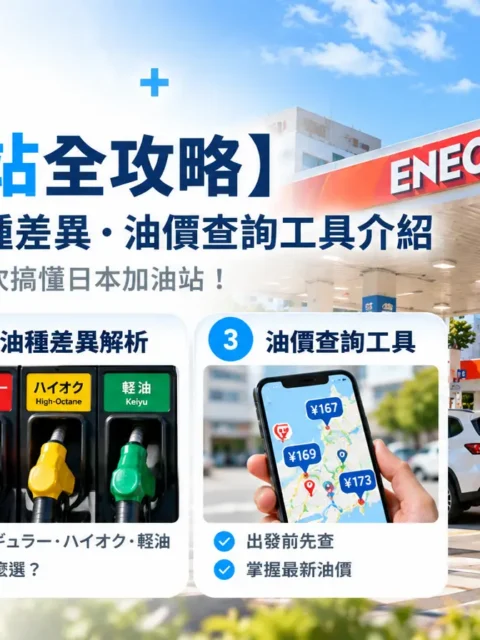
6. Which fuel should I choose?
A: Gas stations in Japan have both full-service and self-service islands.
Here is a comparison table of the fuel labels in Chinese, Japanese and English:
| Fuel type | Nozzle color | Japanese | English |
|---|---|---|---|
| Regular gasoline (95) | Red | レギコラー | Regular |
| Premium gasoline (98) | Yellow | ハイオク | Premium |
| Diesel | Green | 軽油 | Diesel |

Filling up at a Japanese gas station is very simple and convenient, and works almost the same way as in Taiwan.
Self-service steps:
1. Choose the fuel, the amount and the payment method:
On the pump screen, select the fuel type you want, then follow the on-screen instructions to decide how much to put in (by liters or by amount of money); you can also choose to fill the tank (usually the 「満」 (full) option).
Once you have picked the fuel and the amount, you can choose how to pay: by credit card, at the self-service payment machine next to the pump, or at the staffed counter.
2. Fill up:
Open the fuel filler, insert the nozzle and squeeze the handle to start fueling. The pump stops automatically once your selected amount is reached. Then carefully return the nozzle to its holder and close the fuel cap tightly. Finally, don’t forget to collect your receipt and any change.
(If you pay with cash, the payment machine 料金機 (fare/payment machine) is usually nearby, so look around carefully!)
This “Osaka car rental” guide gives you detailed information to help you prepare before renting a car in Osaka, so your self-drive trip goes smoothly and worry-free. Whether this is your first visit to Osaka or you already know the city well, renting a car is a flexible and convenient option that lets you explore Osaka and the surrounding region more fully. We sincerely hope your rental experience is enjoyable and rewarding, and that it adds wonderful memories to your upcoming trip to Osaka!
More articles on car rental and travel in Japan:
👉[Japan Car Rental] 2024 rental guide and cost comparison for a freewheeling trip across Japan!
👉[Tokyo Car Rental] Recommended cars, rental company comparison and tips: everything about a Tokyo self-drive trip!
👉[Okinawa Car Rental Must-Read] Recommendations, cost comparison and self-drive tips in one complete guide!
👉[Kyoto Car Rental] Recommended rentals in Kyoto and self-drive tips for a hassle-free trip!
👉[Hokkaido Car Rental] Recommendations and the latest 2024 guide: the best way to drive through snow country!
👉[Fukuoka Car Rental] Recommendations, company comparison and a complete Fukuoka self-drive guide!
👉[Nagoya Car Rental] The latest rental company price comparison and insurance tips: drive your way around central Japan!
Where should you rent a car in Osaka?Try gogoout!
Worried about spending hours deciding which rental company to book with, struggling with the language, puzzling over complicated insurance options, or driving in an unfamiliar place? Does it all keep you from making a decision?
This article was translated by AI from the original Chinese version.