If you’re planning a self-drive trip in Japan, the most important thing to watch out for is how Japan’s traffic rules differ from Taiwan’s. Besides driving on the right-hand side of the car and keeping to the left, STOP signs, yellow and white road lines, traffic lights, pedestrian right of way and parking rules are all details that first-time drivers in Japan easily overlook.
The most important principles for self-driving in Japan are: keep to the left, stop and yield at intersections, and follow the traffic signs and road markings. In particular, solid white lines and solid yellow lines on Japanese roads don’t always mean the same thing as the markings you’re used to in Taiwan.
This article covers Japan’s latest traffic rules for 2026, from right-hand-drive tips and common traffic signs to yellow and white road lines, traffic tickets and what to do after an accident, so first-time drivers in Japan can quickly get up to speed before hitting the road.
內容目錄
1. Which side do you drive on in Japan? Right-hand drive, keep left, and three core rules
Japan uses right-hand-drive cars that keep to the left. The first time you sit in the driver’s seat, your field of view and your sense of where the car sits on the road will feel completely different from driving in Taiwan. Remembering the basic tips below and the three core rules is the first step to getting on the road smoothly.
Tips for quickly adapting to right-hand drive and keeping left
- Keep the driver’s seat near the center line: while driving in your lane, keep reminding yourself that “the driver’s seat should stay close to the yellow center line or lane divider.” As long as you stay toward the inside of the lane, the car won’t drift toward the shoulder.
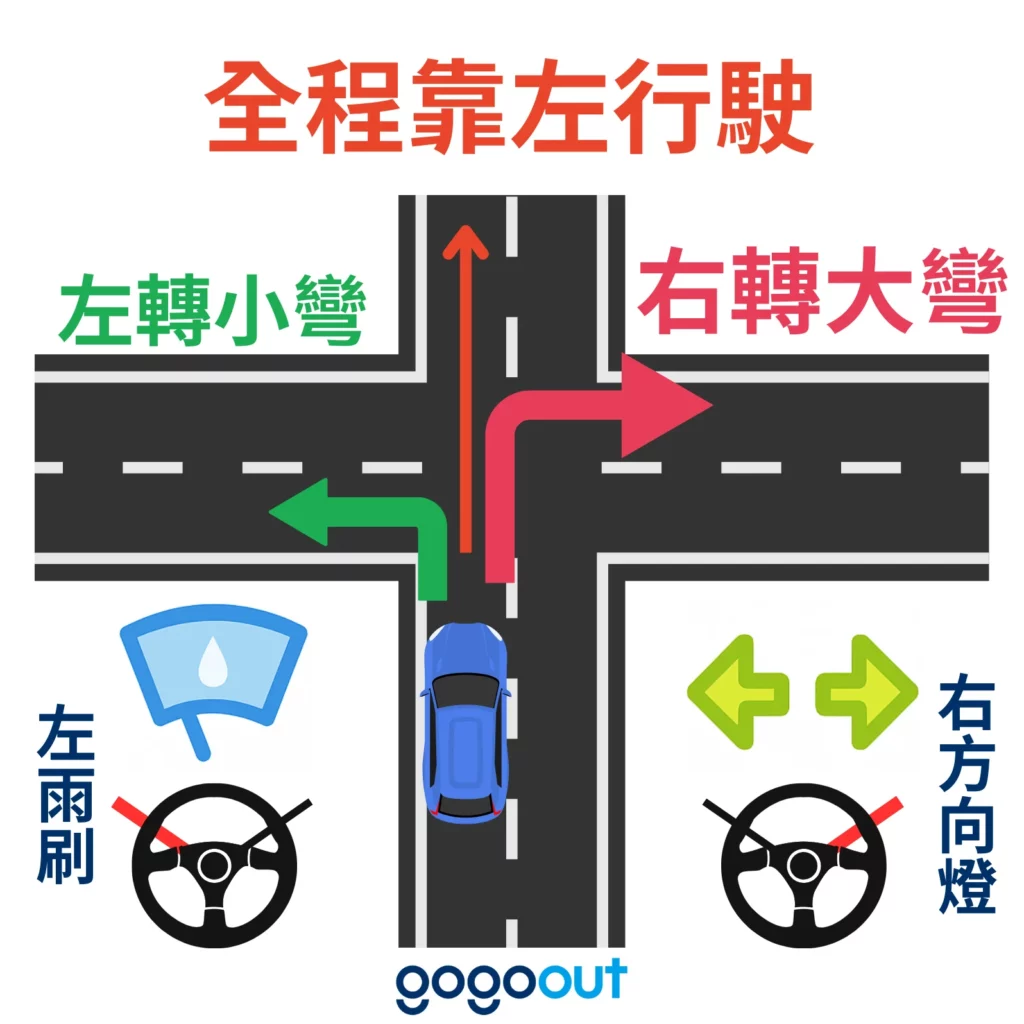
- Tight left turns, wide right turns: when turning left, follow the left lane around (a tight turn). When turning right, you must first yield to oncoming traffic going straight, then pass the center of the intersection before turning into the left lane of the cross street (a wide turn).
- Turn signal and wiper stalks are swapped: on most Japanese cars the turn signal stalk is on the right side of the steering wheel and the wiper stalk is on the left. When you first start driving it’s easy to turn on the wipers when you meant to signal, so say the command to yourself before each turn to build muscle memory.
Three steps to get used to right-hand drive after picking up your car
After picking up your car at the rental branch, don’t drive straight into city traffic. Spend about 10 minutes in the branch parking lot going through the checks below:
- Adjust everything while parked and check the stalks: set the seat height and the angle of the rearview and side mirrors. If you’re using your phone for navigation, set the route before you set off.
- Drive slowly around the lot to get a feel for the brakes: circle the parking lot at around 10 km/h, or start out on quiet, simple roads, to get used to keeping left and judging the distance between the car and the roadside. Then gradually move on to busier city streets.
- Check your lane before turning: at a turn, slow down first and look at the road markings. Right turns in particular mean crossing oncoming traffic, so check the signals and approaching cars instead of falling back on your Taiwanese right-turn habits.
Three major safety rules for self-driving in Japan
Japan enforces several major violations very strictly, and the penalties can even extend to your passengers:
- Zero tolerance for drunk driving (shared liability): Japan’s standard for drunk driving is extremely strict (a breath alcohol concentration of 0.15 mg/L already counts as drunk driving). More importantly, Japanese law imposes shared liability: whoever provided the vehicle, whoever served the alcohol, and any passenger who rode along knowing the driver had been drinking all face criminal fines and charges.
- No handheld phone use while driving: in Japan it’s illegal to hold a phone to make calls while driving, or to keep staring at your phone or navigation screen. Using Google Maps or the in-car navigation isn’t banned outright, but operating or watching the screen must not affect driving safety. If you need to change your route, look up an attraction or call the rental company, find a safe spot where parking is allowed, stop the car and then use your phone.
- Seat belts for everyone, child seats for kids under 6: by law, everyone in the car (including rear-seat passengers) must wear a seat belt at all times. If you’re traveling with an infant or child under 6, be sure to add a child safety seat when you book your rental car.
2. Japanese driving rules and right of way you need to know before you drive
Understanding who has right of way and the key signals is the key to avoiding accidents. Japanese traffic law places heavy emphasis on “pedestrians always have priority” and “come to a full stop and yield.” Below are the Japanese driving rules you must follow strictly on the road.
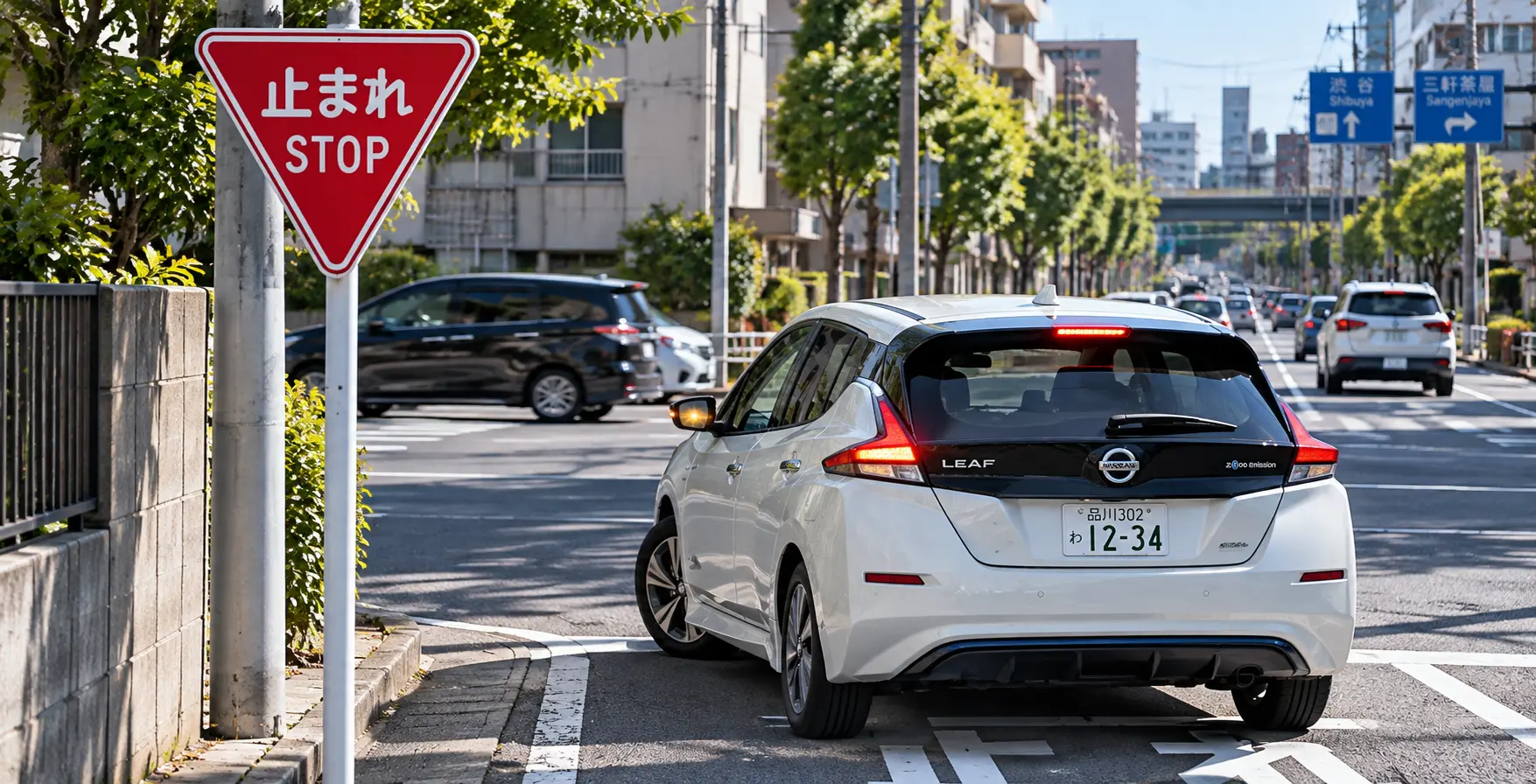
The 「止まれ」 (stop) sign and railroad crossings
One of the most common signs on Japanese roads is the inverted red triangle with the white characters 「止まれ」 (stop; some signs also include the English word STOP), along with the white stop line painted on the road surface.
- Bring the wheels to a complete stop before proceeding: at a 「止まれ」 (stop) intersection, the car must come to a dead stop before the stop line (speed at zero, no rolling through), count at least 3 seconds in your head, and turn your head to check left and right for cars and people before moving off.
If you merely slow down and roll through, the police will ticket you for failing to make a complete stop.- Here’s the correct procedure:
- Slow down well before the stop line
- Bring the car to a complete stop before the stop line
- Check for approaching cars, pedestrians and cyclists on both sides
- If your view is blocked, creep forward to a point where you can see safely, and stop again if necessary
- Proceed through the intersection once you’ve confirmed it’s safe
- Here’s the correct procedure:
- Always stop at railroad crossings: before crossing any railroad crossing, whether or not the alarm is sounding, you must come to a complete stop before the stop line, look both ways, and make sure there’s enough space on the far side for the whole car to clear the tracks before proceeding.
Reading traffic signals: no turning on red
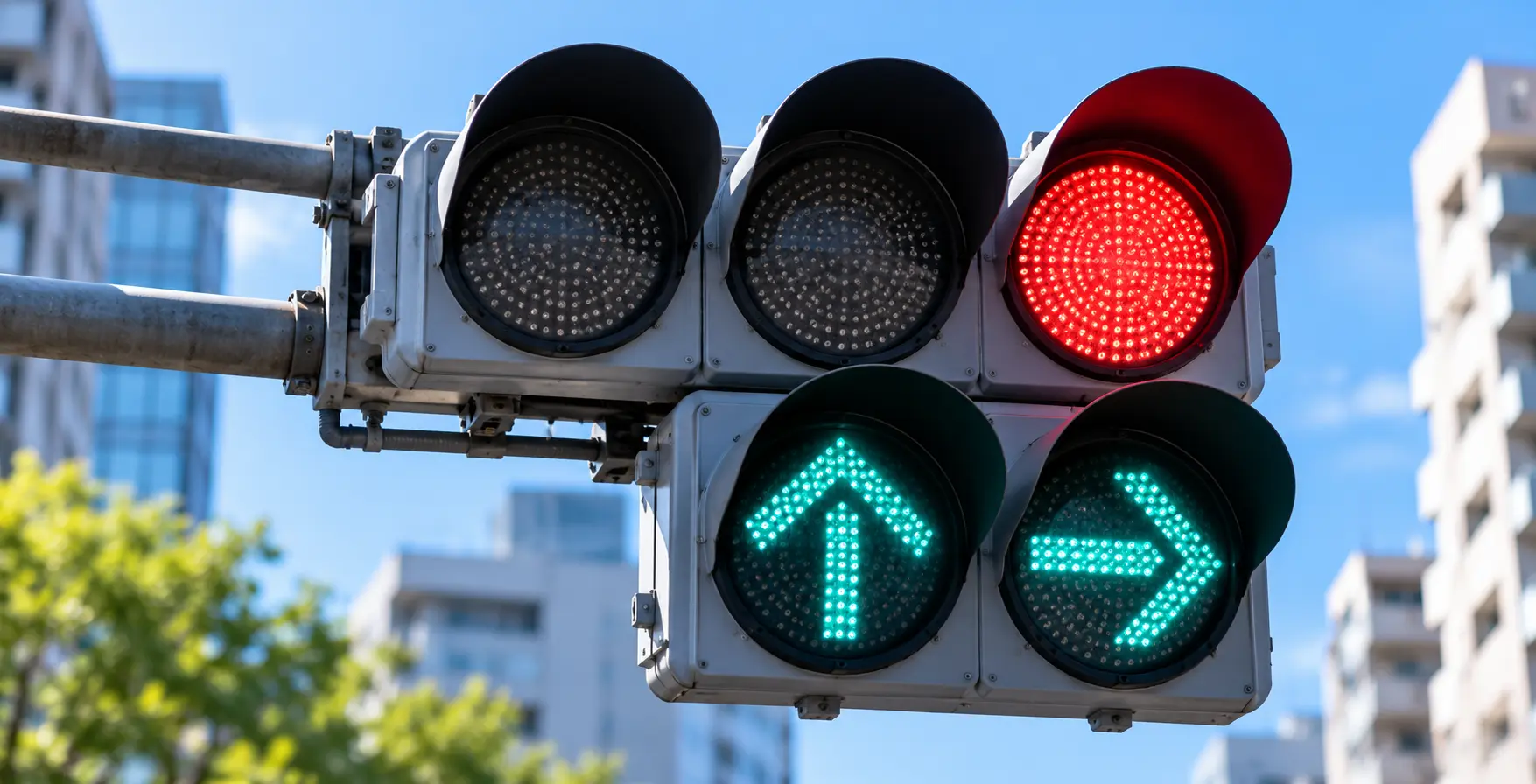
Japan’s traffic signals are fairly intuitive, but two things differ from what you’re used to in Taiwan:
- No left or right turns on red: whenever the round red light is on, every vehicle must stop before the stop line. Unless an additional green arrow signal is lit, you may never turn on red.
- Round red light plus green right-turn arrow: in this case only vehicles turning right may proceed; cars going straight or turning left must wait. When the green right-turn arrow is lit, oncoming traffic usually has a red light too, but you still need to watch for pedestrians in the crosswalk as you turn.
- Yellow arrow signals: these are dedicated signals for streetcars (such as the city trams in Nagasaki, Kumamoto and Hiroshima). If you’re driving a regular car, ignore the yellow arrow and follow the standard traffic lights.
| Traffic signal | Japanese traffic rule |
|---|---|
| Red light | You must stop; as a rule, no left or right turns |
| Yellow light | As a rule you must stop, unless you can no longer stop safely before the stop line |
| Green light | You may proceed as permitted, but still watch for pedestrians, other vehicles and turning right of way |
| Green directional arrow | Even if the main light is red, you may proceed in the direction shown by the arrow |
| Yellow directional arrow | Mainly for streetcars; regular cars may not proceed on this arrow |
| Flashing red light | You must come to a complete stop first, then proceed when it’s safe |
| Flashing yellow light | Watch the surrounding traffic and proceed when it’s safe |
What are the common traffic signs in Japan?
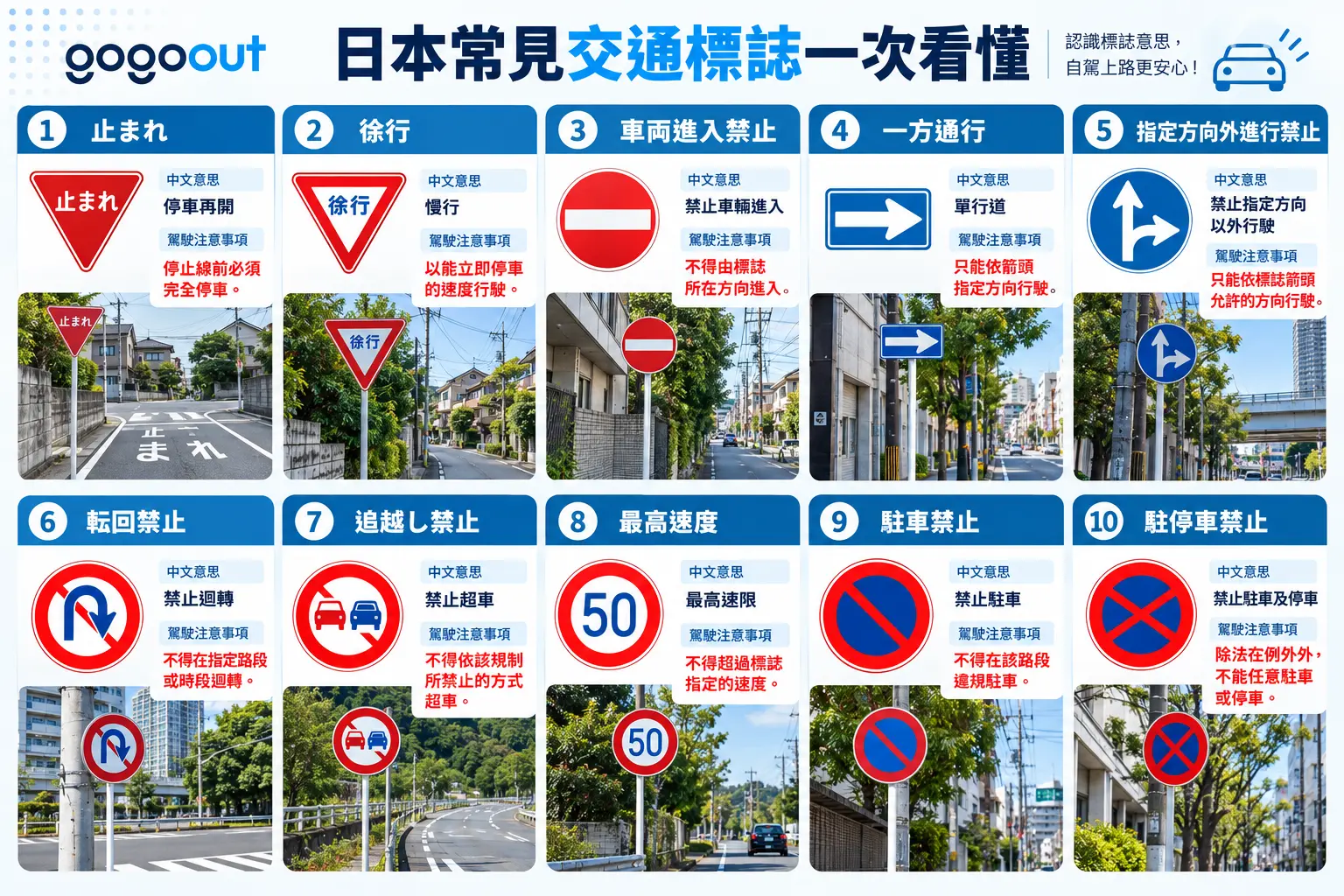
Besides traffic lights, Japanese roads have many regulatory signs, including no entry, one-way street, no U-turn and no parking.
Here are the traffic signs you’ll most often come across while self-driving in Japan:
| Japanese sign name | Meaning | What drivers need to know |
|---|---|---|
| 止まれ | Stop and proceed | You must come to a complete stop before the stop line |
| 徐行 (slow down) | Slow down | Drive at a speed that lets you stop immediately |
| 車両進入禁止 (no entry for vehicles) | No vehicle entry | You may not enter from the direction the sign faces |
| 一方通行 (one way) | One-way street | You may only drive in the direction of the arrow |
| 指定方向外進行禁止 (no travel except in the directions shown) | No travel in directions other than those indicated | You may only go in the directions allowed by the arrows on the sign |
| 転回禁止 | No U-turns | No U-turns on the specified stretch of road or during the specified hours |
| 追越し禁止 (no passing) | No passing | You may not pass in the manner prohibited by the regulation |
| 最高速度 (maximum speed) | Maximum speed limit | You may not exceed the speed shown on the sign |
| 駐車禁止 (no parking) | No parking | You may not park illegally on this stretch of road |
| 駐停車禁止 (no parking or stopping) | No parking and no stopping | Apart from the exceptions allowed by law, you may not park or stop here |
In Japan, some signs also carry supplementary plates showing hours, vehicle types or distances.
For example, if a stretch of road bans parking only during certain hours, that does not mean parking is automatically allowed at other times, as the general legal parking bans still apply.
Right-of-way priority explained
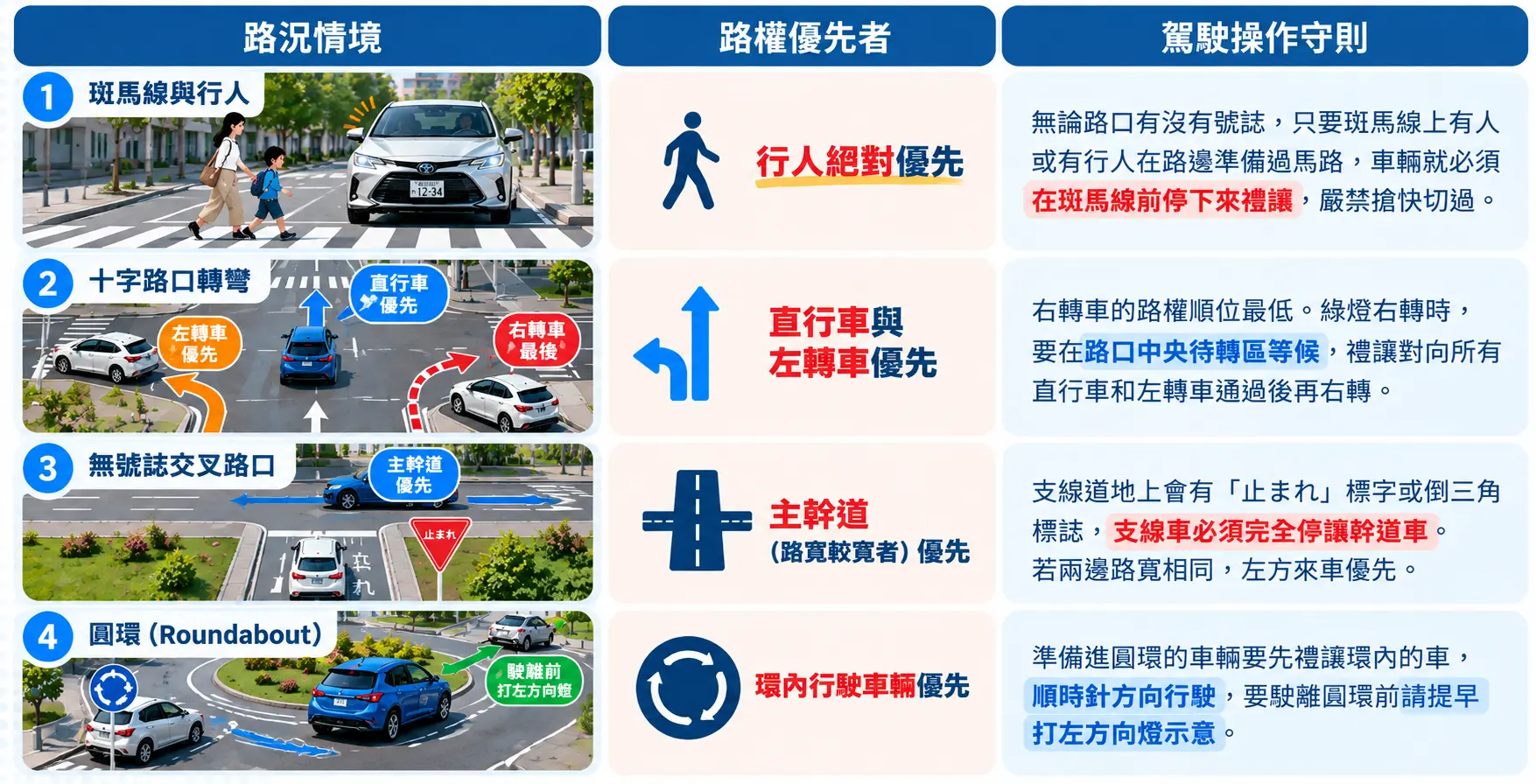
| Road situation | Who has priority | What the driver should do |
|---|---|---|
| Crosswalks and pedestrians | Pedestrians always have priority | Whether or not the intersection has traffic lights, if anyone is on the crosswalk or waiting at the curb to cross, you must stop before the crosswalk and let them go. Never try to cut across ahead of them. |
| Turning at an intersection | Oncoming traffic and left-turning cars have priority | Cars turning right have the lowest priority. On a green light, wait in the center of the intersection and let all oncoming through traffic and left-turning cars pass before you turn right. |
| Unsignalized intersections | The main road (the wider one) has priority | The minor road will have 「止まれ」 (stop) painted on the pavement or an inverted triangle sign, and cars on it must come to a complete stop and yield to traffic on the main road. If both roads are the same width, the car coming from the left has priority. |
| Roundabouts | Cars already in the roundabout have priority | Before entering a roundabout, yield to the cars already circulating. Traffic flows clockwise, and you should signal left well before your exit. |
Speed limits and the new rules for residential streets
Japan sets clear legal speed limits for different types of roads, but always follow the signs you see on the spot:
- Expressways (自動車道, motorways): the limit is usually 100 km/h, rising to 120 km/h on some sections (such as the Shin-Tomei Expressway and certain stretches of the Tohoku Expressway), with a legal minimum speed of 50 km/h.
- General suburban and urban arterial roads: the legal limit is usually 50 km/h to 60 km/h.
- Residential streets with no center line (latest rule): from September 1, 2026, qualifying residential streets without a center line or lane markings will see their legal maximum speed drop from 60 km/h to 30 km/h. That does not mean every road without a posted limit is capped at 30 km/h, so still judge by the road type and the posted limit.
3. How to read Japan’s yellow and white road markings: solid lines, dashed lines and passing rules
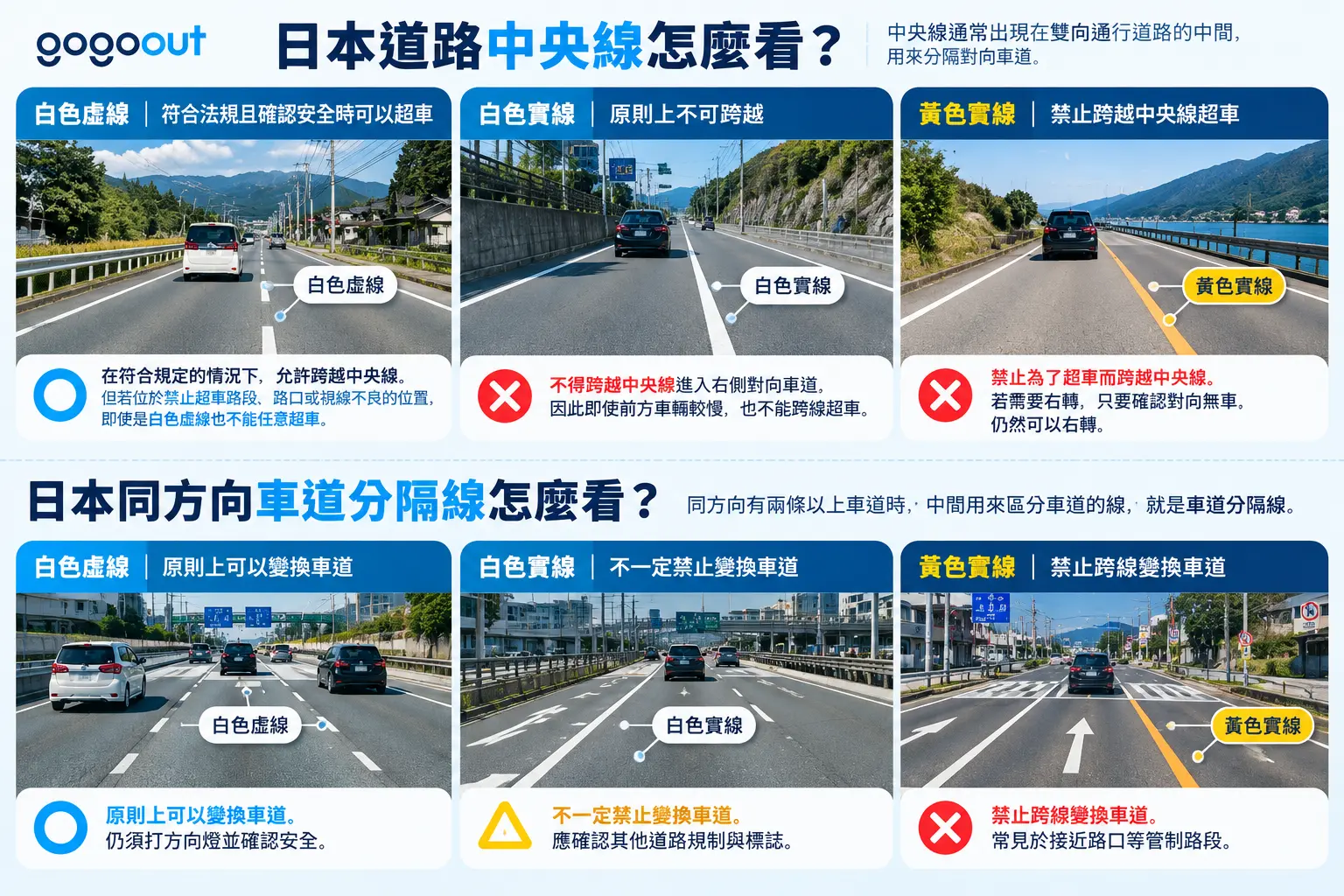
White dashed, white solid and yellow solid center lines in Japan
When driving in Japan, besides the traffic lights and signs, the white dashed, white solid and yellow solid lines on the road matter a lot too.
You can’t judge whether you may cross a line by its color alone, because Japanese road markings are also divided into “center lines” and “lane dividers.”
- Center line (センターライン): separates traffic moving in opposite directions.
- Lane divider (車線境界線, lane boundary line): separates lanes moving in the same direction.
The rules for the two are different, so it’s worth understanding them separately.
The difference between white dashed, white solid, and yellow solid center lines in Japan
Center lines usually appear in the middle of two-way roads, and their main job is to separate opposing lanes of traffic.
| Type of center line | What it means | Can you cross it to pass? |
|---|---|---|
| White dashed line | Crossing the center line is allowed when the rules permit it | Yes, when it is legal and you have confirmed it is safe |
| White solid line | As a rule, you may not cross the center line into the oncoming lane on the right | As a rule, no |
| Yellow solid line | Crossing the center line to pass is prohibited | No, you may not cross it to pass |
Even when two lines are the same color, yellow or white, the rules for crossing them are not necessarily the same.
1. White dashed line: you may cross it as permitted, but that doesn’t mean you can pass at any time
If the center of the road is marked with a white dashed line, you may cross it as long as you follow the traffic rules and conditions are safe. But on stretches where passing is prohibited, at intersections, or anywhere with poor visibility, you still may not pass freely, even with a white dashed line.
2. White solid line: you may not cross into the oncoming lane
A white solid line down the center of a Japanese road means vehicles may not cross the center line into the oncoming lane on the right. So if the car ahead of you is moving slowly, you can’t simply cross the white solid line into oncoming traffic to pass.
3. Yellow solid line: crossing the center line to pass is prohibited
A yellow solid line means you may not cross the line in order to pass, so whenever you need to change lanes on the road, a yellow line is off limits.
That said, on a two-lane road where you need to cross the yellow line to turn right, you may make the turn as long as you’ve confirmed there is no oncoming traffic!
How do you read lane dividing lines for traffic going the same way in Japan?
If a road has two or more lanes running in the same direction, the lines between them are lane dividing lines.
| Lane dividing line | Can you change lanes? | Things to watch for |
|---|---|---|
| White dashed line | As a rule, yes | You still need to signal and confirm it is safe |
| White solid line | Not necessarily prohibited | Check other road restrictions and signs |
| Yellow solid line | Crossing the line to change lanes is prohibited | Common on controlled stretches such as approaches to intersections |
Note in particular that in Japan a white solid lane dividing line does not necessarily mean lane changes are prohibited, which is different from the meaning of a white solid center line.
A yellow solid lane dividing line, on the other hand, usually means lane changes are prohibited. For example, as you approach an intersection and have already entered the right-turn lane, if a yellow solid line marks the side of your lane, you can’t suddenly swing out of it just because you’d rather go straight.
When yellow and white lines run side by side, can you cross them or change lanes?
On some roads in Japan you’ll see a white line and a yellow line running side by side. In that case you have to judge by what each line is for and by the rule that applies to the side your lane is on.
For example, between lanes going the same direction, if one side is a yellow solid line and the other is a white line, the lane changes allowed in each direction may differ. When you come across markings like these, pay special attention to the following:
- First work out whether it’s a center line or a lane dividing line for traffic going the same way.
- Judge by the traffic restriction that applies to the side your lane is on.
- Watch for signs prohibiting passing or lane changes.
- Don’t suddenly cross a prohibited line just because you’re about to miss your turn.
An easy way to remember it: with Japan’s yellow and white lines, color alone isn’t enough. You also need to look at where the line is painted on the road and whether it restricts crossing into oncoming traffic, passing, or changing lanes.
4. Driving culture in Japan: driving etiquette you need to know
Beyond the hard rules, knowing local self-drive etiquette in Japan and the unwritten understandings between drivers will make the whole trip go much more smoothly, and keep you from troubling local residents.
The thank-you hazard lights
In the city, when traffic is heavy and you need to merge from a side road onto the main road or change lanes, if the car behind slows down and flashes its headlights to let you in, you can flash your hazard lights two or three times once you’re in the lane to say thanks. This is a very common courtesy among drivers in Japan.
When to use your horn, and when not to
When driving in Japan, the law says you may not use your horn casually, except in these two situations:
- Driving on blind curves or mountain roads marked with a 「警音鳴らせ」 (sound your horn) sign.
- Sounding an emergency warning in the face of sudden danger, to avoid a collision.
If the car ahead of you is a little slow pulling away at a red light in town, or the driver is hesitating while looking for the way, be patient and don’t honk to hurry them along.
Zipper merging and rules for the passing lane on the expressway
- Zipper merging at interchanges: at expressway interchanges or where lanes narrow, Japanese drivers follow the zipper principle of one car at a time, taking turns in order. Don’t speed up to force your way in, and don’t tailgate the car ahead to keep others from merging.
- Never hog the passing lane on the expressway: the rightmost (inside) lane on an expressway is the 「追越車線」 (passing lane), while the others are 「走行車線」 (travel lanes).
After passing, move smoothly back into the travel lane on the left as soon as there’s a safe gap. If you stay in the passing lane for more than 2 kilometers, police can pull you over and ticket you for a lane-use violation even if you weren’t speeding.
Keep a safe distance from bicycles (new rule)
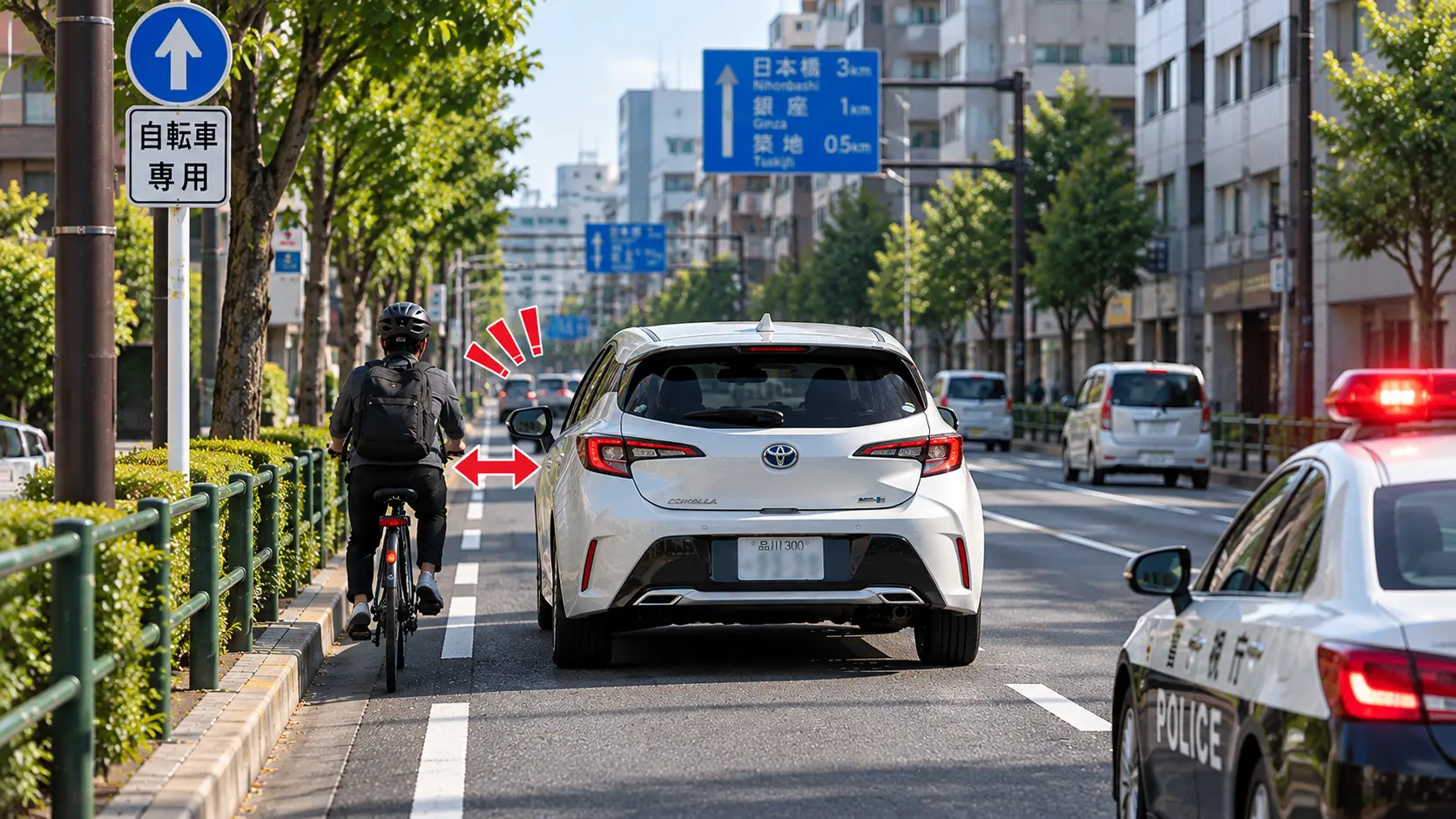
Japan’s latest rules give bicycles a strong right of way! When passing a bicycle traveling in the same direction on an ordinary road, leave at least 1 meter of lateral space. If the road is too narrow to pass safely, slow down and stay behind the bicycle instead of crowding the rider.
What should I do if I meet an emergency vehicle or take a wrong turn while driving in Japan?
- Meeting an ambulance or fire truck
When an emergency vehicle such as an ambulance or fire truck approaches, drivers must yield as required by traffic law. Near an intersection, avoid blocking the emergency vehicle’s path and, if necessary, pull over and stop in a safe spot.
Don’t brake suddenly, cross the center line at will, or change lanes abruptly without checking that it’s safe.
2. If the navigation leads you the wrong way, can you just make a U-turn?
Not necessarily. Some roads in Japan have a 「転回禁止」 (no U-turn) sign, and U-turns may also be restricted by the center line, the intersection or other traffic rules. If you accidentally take a wrong turn, the safest thing to do is keep driving, let the navigation recalculate the route, and change direction at a legal, safe spot.
Don’t swerve across lanes, cross a prohibited road marking, or back up on the expressway just to get back on your original route.
5. Practical tips for parking and expressway ETC
Understanding Japan’s parking rules and payment methods can save you a lot of money in fines and plenty of precious travel time.
No casual curbside stopping
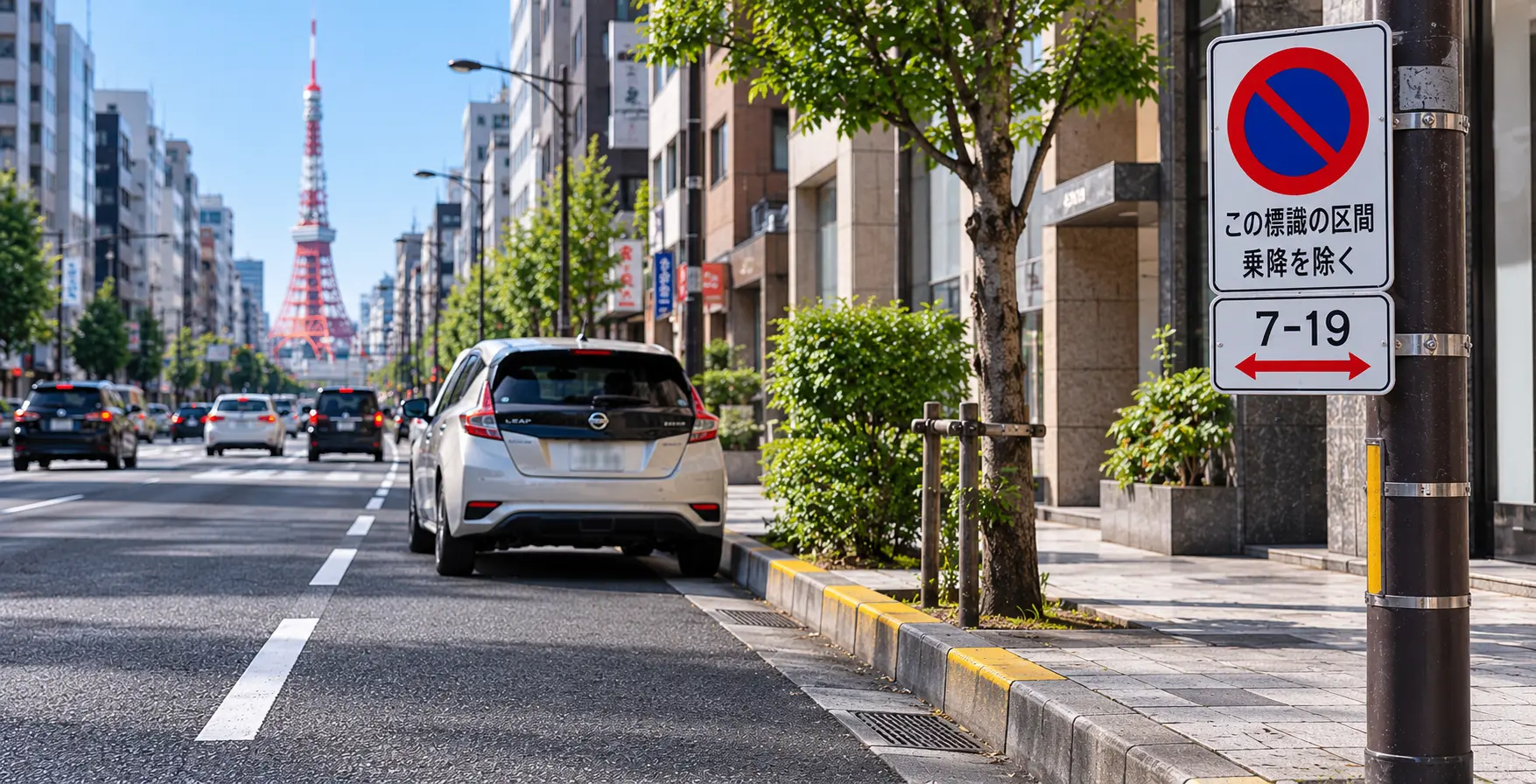
In Japanese city centers, there is basically no such thing as “pulling over at the curb for a quick errand.” Even in a side street with no red or yellow lines, if there’s no sign permitting parking, stopping for just a few minutes can get you photographed and ticketed by a patrol officer (放置車両確認事務委託員, parking enforcement contractor).
So when you need to park, heading to a nearby parking lot is always the safest option. If you don’t see a sign permitting parking on that stretch of road and you want to stop on the roadway side, check the curb markings along the sidewalk:
Dashed yellow line: brief stopping allowed, but no standing parking
Solid yellow line: stopping and parking are completely prohibited
How to use common paid parking lots in Japan
- Flap-lock lots (tire locking plate): About 2 to 3 minutes after you park in a space, a metal flap under the car rises automatically. To leave, go to the payment machine first and enter your space number, check the amount and pay with coins or a card, then wait for the flap to lower completely and drive out within 3 to 5 minutes.
- License-plate recognition / gated lots: On entry, the system photographs your plate automatically or you take a ticket. Before leaving, go to the “advance payment machine” in the mall or in the lot, enter your plate number and pay; when you drive up to the exit gate, the system recognizes the car and raises the barrier.
To learn how to tell what a parking lot actually charges, see our complete guide to parking lots in Japan, which helps you spot the “maximum rate” traps.
ETC lane rules on the expressway
On Japanese expressways, toll gate lanes mainly come in two types: “ETC only” and “general”:
- ETC-only lanes: Your car must have an ETC card reader with a valid Japanese ETC card inserted. When passing through the toll gate, be sure to slow down to under 20 km/h and wait until the card is read and the barrier rises before driving through.
- General lanes: If you didn’t rent an ETC card, use the lane marked “general”: take a toll ticket when you enter, and hand the ticket plus cash or a credit card to the attendant when you exit.
To learn how tolls are calculated and how renting works, see our guide to ETC card rental and expressway tolls to help you plan long-distance routes.
6. Violations and accidents | What to do if you get a ticket or have a crash
If you have a traffic violation or a vehicle accident while renting a car in Japan, make sure the scene is safe first, then contact the police and the rental company as required. Don’t assume you can handle it yourself just because it seems like a minor violation, a small scratch, or because no other vehicle was damaged.
Japan’s traffic ticket system | Blue ticket vs. red ticket
| Type | Blue ticket (青キップ) | Red ticket (赤キップ) |
|---|---|---|
| When it applies | Violations covered by the traffic infraction notification system | More serious violations, or ones not eligible for the infraction fine procedure |
| How it’s handled | Pay the infraction fine as required and the case is exempt from ordinary criminal proceedings | Usually goes into criminal proceedings, handled case by case |
| Common examples | Some speeding offenses, improper parking, etc. | Serious speeding, drunk driving and other violations that may carry criminal liability |
| Things to note | Check the payment deadline and procedure (usually cash only; credit cards are not accepted) | Follow the instructions of the police, prosecutors and other authorities |
Step-by-step guide if you get a parking ticket
If you find a parking violation notice on your windshield while renting a car in Japan, or the police contact you, follow these steps:
Step 1: Check what the notice says: Look at the location, date and other details of the violation on the notice, and don’t just throw it away. Take the notice, your passport and your rental agreement to the police station (交番, police box) listed on the notice to complete the paperwork and your statement.
Step 2: Contact the rental shop right away: Let the shop know about the violation and follow the instructions of the police and the shop. Different violations may have different payment and handling procedures.
Step 3: Complete payment or any follow-up steps as required: Once you receive the official 「納付書」 (payment slip), pay the fine in person at a nearby bank or Japan Post office, and be sure to keep the receipt.
Step 4: Check whether you need to show proof when returning the car: When you return the car to the rental company, be sure to show the police statement certificate and the payment receipt. If you don’t follow the proper procedure, your rental contract may impose extra charges or leave you responsible for further handling.
3 emergency steps if you’re in a traffic accident
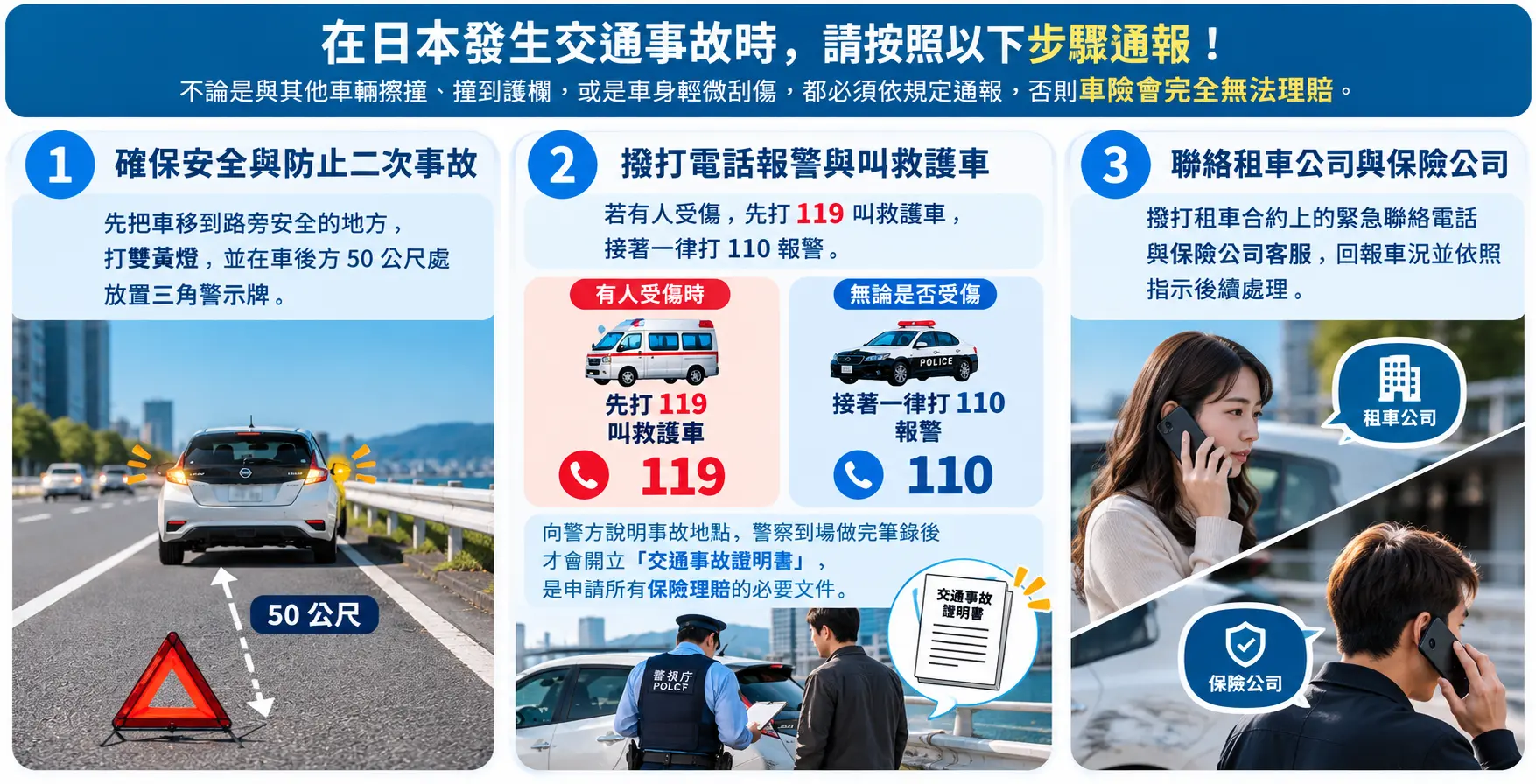
While driving in Japan, whether you scrape another vehicle, hit a guardrail, or just lightly scratch the car, you must report it following the steps below or your insurance will not cover anything:
- Secure the scene and prevent a second accident
Move the car to a safe spot at the roadside, turn on your hazard lights, and place a warning triangle 50 meters behind the car
- Call the police and an ambulance
If anyone is injured, call 119 for an ambulance first, then always call 110 for the police. Tell the police where the accident happened; only after officers arrive and take your statement will they issue a “traffic accident certificate” (the document required for any insurance claim).
- Contact the rental company and the insurer
Call the emergency number on your rental agreement and the insurance company’s customer service, report the condition of the car and follow their instructions.
To avoid being stuck with a large deductible and loss-of-use compensation if something happens, make sure you understand your insurance coverage when you pick up the car.
For what to look for in detail, see our complete guide to Japan car rental insurance (CDW/NOC).
7. FAQ about Japan’s self-drive traffic rules
Japanese traffic law requires vehicles to come to a complete stop before the stop line, but there is no blanket rule that you must stay stopped for three seconds at every STOP sign. Drivers should make sure the vehicle has stopped completely, check the surrounding traffic, and only continue once it is safe.
A yellow center line means you may not cross into the oncoming lane to overtake, though there can be legal exceptions when an obstacle is in the way. A solid yellow line between lanes going the same direction means changing lanes across it is prohibited.
Not necessarily. As a rule, you may not cross a solid white center line into the oncoming lane on the right. A solid white line between lanes going the same direction does not automatically mean lane changes are banned, but you still have to follow other signs and road regulations.
Japan drives on the left and the driver’s seat is usually on the right, so for travelers used to driving on the right in Taiwan, it is especially easy to turn into the wrong lane or enter an intersection the wrong way. At a 「止まれ」 (stop) sign you must come to a complete stop and check that it is clear. At a crosswalk, you must also stop and let pedestrians go first if someone is crossing or about to cross.
Call the police even for a minor scrape with no injuries. After a crash, move the vehicle to a safe spot first, then check on everyone involved if it is safe to do so. If anyone is hurt, call 119 for an ambulance first, then call 110 for the police. Afterward, contact the rental company and follow their instructions for handling the vehicle, insurance and the rest of the process.
If you receive a 青切符 (aokippu, blue ticket), which falls under the traffic violation notification system, the police will also hand you a payment slip; pay by the deadline and in the manner stated on it. Under the Tokyo Metropolitan Police Department’s rules, for example, you can generally take the payment slip to a designated financial institution such as a bank, credit union or post office.
Because procedures can differ by case and type of violation, do not simply hand the fine to the rental company and assume it is paid! Follow the instructions on the documents issued by the police, and if anything is unclear, ask the rental company to help you confirm.
Don’t ignore the ticket! If the police have issued you a traffic violation notice and a payment slip, take care of it by the stated deadline. With a standard 青切符 (aokippu, blue ticket), paying the penalty within the deadline closes the case under the traffic violation notification system. If you don’t follow the procedure, the case may move on to further notices or even criminal proceedings.
Final thoughts: get familiar with Japan’s road signs and rules before you drive
Self-drive travel in Japan is convenient, but driving habits still differ quite a bit from Taiwan. Right-hand drive and keeping left, STOP signs, pedestrian priority, traffic signals and the yellow and white line rules are all worth understanding before you set off.
If this is your first time driving in Japan, keep these key points in mind:
- When turning, make sure you end up on the left side of the road and don’t drift into oncoming traffic.
- At a STOP sign, come to a complete stop and check that it is safe.
- You can’t turn left or right on a red light as you please.
- With yellow and white lines, tell the difference between center lines and lane dividers; color alone isn’t enough.
- At a crosswalk, follow the pedestrian-priority rule.
- Drive according to the road signs and the current speed limits.
- If you have an accident, report it to the police as required and notify the rental company.
As long as you learn Japan’s traffic rules in advance, follow the signs on the road and keep safe driving habits, you can enjoy the convenience and flexibility of a self-drive trip in Japan with peace of mind.
Planning your self-drive trip in Japan? Head to the gogoout Japan car rental comparison page to quickly compare deals from major nationwide chains and local rental shops, with transparent pricing and Chinese-language customer support to help you sort out your car with ease!
This article was translated by AI from the original Chinese version.