When you’re planning a self-drive trip in Japan, whether you’re taking the popular Okinawa car rental route or heading out on a Hokkaido self-drive route, understanding how Japan car rental insurance is structured is the most important step before you set off. Many first-time self-drivers assume that “the rental price includes insurance, so I won’t have to pay anything if something happens”—only to discover their coverage falls far short when a minor scrape leads the rental company to charge them tens of thousands of yen in deductibles and loss-of-business fees.
This article walks you through the four levels of Japan car rental insurance, explains the difference between CDW, NOC and full coverage, and covers the claims process after an accident plus the five mistakes that most often void your coverage.
內容目錄
The 4 levels of Japan car rental insurance: coverage at a glance
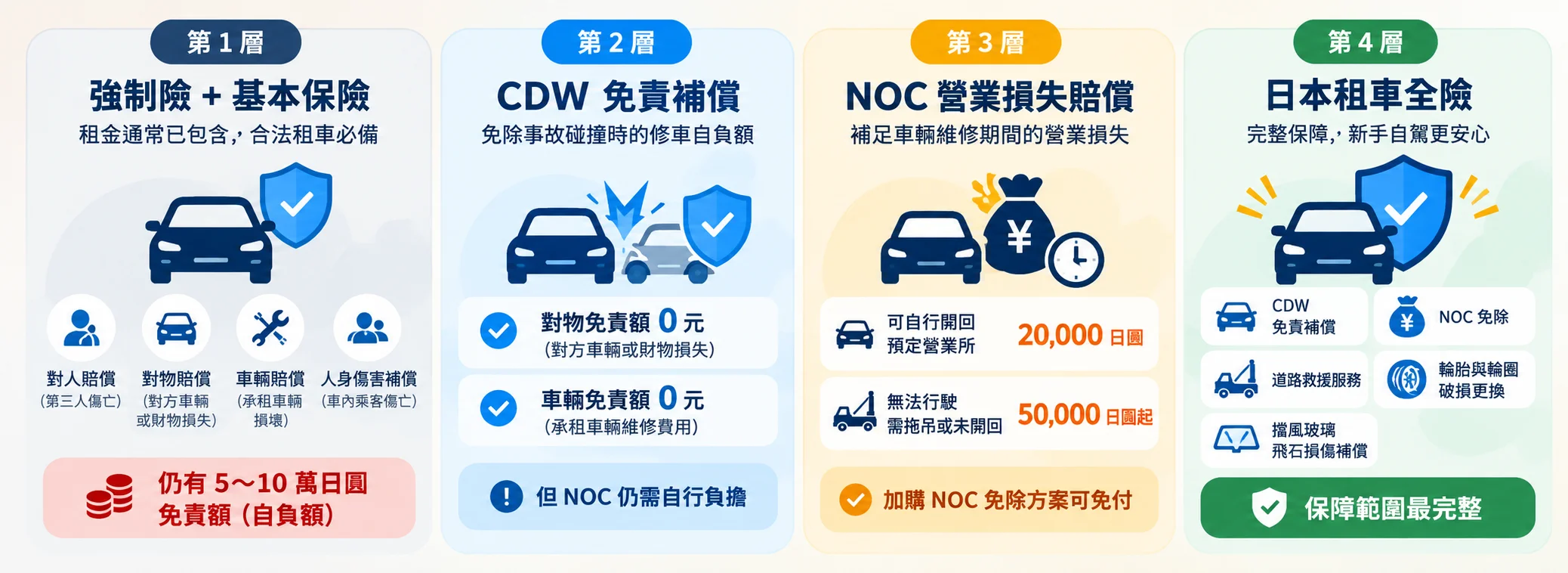
Japan car rental insurance is built up in four layers, from the basic legally required insurance to the rental companies’ top-tier zero-deductible full coverage plans. Each layer covers a different set of risks:
Level 1: Compulsory insurance (jibaiseki) + basic insurance
As long as you rent a car legally in Japan, the rental price normally already includes the legally required “自動車損害賠償責任保険” (compulsory automobile liability insurance, known as jibaiseki) plus the “基本任意保険” (basic optional insurance) that the rental company adds.
This layer mainly covers: personal injury liability (injury or death of a third party), property damage liability (damage to the other party’s vehicle or property), vehicle damage (damage to the rental car itself) and personal accident coverage (injury or death of passengers in your car).
It looks comprehensive, but this basic insurance comes with a “deductible (excess).” If you have an accident, the property damage liability and the vehicle repair costs each usually carry a deductible of ¥50,000 to ¥100,000. You have to pay that amount yourself, and the insurer only covers the portion above the deductible.
Level 2: CDW (Collision Damage Waiver)
CDW stands for Collision Damage Waiver. The point of adding CDW is to reduce the property damage deductible and the vehicle damage deductible from Level 1 to zero. If the car is involved in a collision, you don’t have to pay that ¥50,000 to ¥100,000 repair deductible yourself.
Do note, though, that extra situations such as a windshield chipped by flying stones or a damaged tire are not included in CDW. If you want to avoid paying for that kind of damage, read on to the fourth level: “full coverage.”
CDW costs roughly ¥1,000 to ¥1,500 per day. But be careful: CDW only waives the deductible on repair costs; it does not cover the rental company’s loss of business while the car is being repaired. This is where most people get confused.
Level 3: NOC (Non-Operation Charge)
When a car has to be taken out of service for repair or cleaning because of an accident, a scrape, theft, or serious dirt and odor inside the cabin, the rental company charges the driver a fixed “loss of business” fee, known in Japan as the Non-Operation Charge (NOC).
The standard NOC rates at major Japanese rental companies are usually:
- Car is damaged but you can still drive it back to the branch: ¥20,000.
- Car is too badly damaged to drive, needs towing, or isn’t returned to the branch: from ¥50,000 (towing fees charged separately).
*The amounts above are for reference only; please confirm the actual amounts in the contract provided by the rental company.
Even if you’ve already added CDW, if you haven’t bought the extra add-on that waives the NOC (NOC coverage), you’ll still have to pay that ¥20,000 to ¥50,000 compensation out of your own pocket after an accident.
| Coverage | Basic compulsory insurance | +CDW deductible waiver | +NOC waiver |
|---|---|---|---|
| Personal injury liability (to victims) | ✔️ | ✔️ | ✔️ |
| Property damage liability | ✔️ | ✔️ | ✔️ |
| Vehicle damage coverage | ✔️ | ✔️ | ✔️ |
| Personal accident coverage (for passengers) | ✔️ | ✔️ | ✔️ |
| Deductible waived | ✔️ | ✔️ | |
| Loss-of-business fee waived | ✔️ |
Level 4: Japan full coverage plans (Safety Package / RAP / ECO)
Full coverage in Japan is usually a rental company’s top-tier package (names vary by company, such as Times’ Safety Package, ORIX’s RAP or Toyota’s Anshin W plan). These plans bundle everything together: “CDW deductible waiver + NOC waiver + roadside assistance + tire and wheel damage replacement + windshield stone-chip coverage.”
The main additions are roadside assistance, tire damage and windshield stone-chip coverage—so if you only have the common CDW+NOC combination, any of those situations could still leave you paying out of pocket.
Full coverage costs roughly ¥1,500 to ¥2,500 per day. Since Japan drives on the opposite side from Taiwan, first-time self-drivers easily pick up small scrapes when turning or parking, so it’s worth choosing a plan that includes both the deductible waiver and the NOC waiver. You’ll drive with more peace of mind and won’t have to worry about a big bill after an accident.
Japan car rental insurance comparison table and sample cost calculations
Here’s a comparison of the coverage and costs of four common insurance combinations:
| Coverage item | Basic insurance | Basic insurance + CDW | CDW + NOC waiver | Top-tier full coverage (Safety plan) |
|---|---|---|---|---|
| Basic personal injury / property damage liability | Yes (with deductible) | Yes (no deductible) | Yes (no deductible) | Yes (no deductible) |
| Vehicle repair deductible | You pay ¥50,000–¥100,000 | 0 yen | 0 yen | 0 yen |
| NOC loss-of-business fee | You pay ¥20,000–¥50,000 | You pay ¥20,000–¥50,000 | 0 yen | 0 yen |
| Tires / glass / towing and roadside assistance | Paid by you | Paid by you | Partially covered, depending on the plan | Fully covered / free |
| Reference daily add-on cost | 0 yen | About 1,000–1,500 yen | About 1,500–2,000 yen | About 2,000–2,500 yen |
A real-world single-vehicle accident scenario: backing into a wall and denting the bumper (car still drivable)
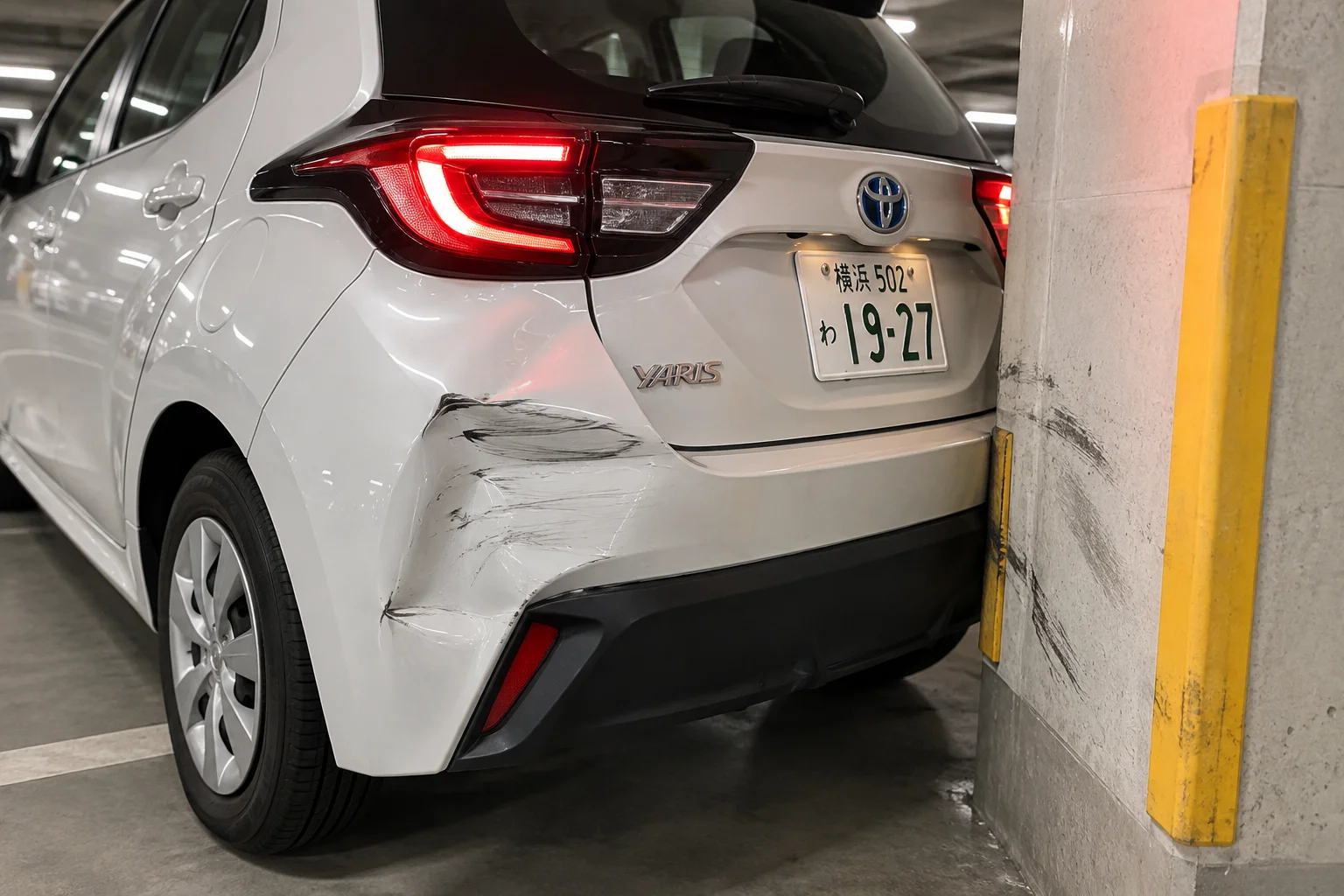
Say you back into a wall in a parking lot and dent the rear bumper, but the car can still be driven back to the branch normally. Here is what you would pay out of pocket under each insurance plan:
- Basic insurance: 50,000 yen vehicle damage deductible + 20,000 yen NOC (non-operation charge) = 70,000 yen out of pocket in total (about NTD 15,000).
- With CDW added: vehicle damage deductible drops to 0 + you still pay 20,000 yen NOC = 20,000 yen out of pocket in total (about NTD 4,300).
- With CDW + NOC coverage added: vehicle damage deductible 0 + NOC 0 = 0 yen out of pocket in total.
5 fatal coverage-voiding pitfalls: when even full coverage pays nothing
Even if you buy the top-tier full-coverage insurance for car rental in Japan, breaking Japanese traffic laws or your rental contract voids the insurance outright, and you have to pay for every loss yourself. Be sure to avoid these 5 common pitfalls:
- Not calling the police for an accident certificate (交通事故証明書, traffic accident certificate): In Japan, whether you collide with another car, hit a utility pole, scrape the undercarriage or even just chip the paint, you must call 110 immediately whenever an accident happens. Without a police report on file, the insurer can refuse your claim outright.
- Driving by someone who is not a registered driver: When you sign the contract at pickup, everyone who will drive must present a driver’s license and Japanese translation to be registered as a driver. If the driver involved in the accident is not on the contract, the insurance pays nothing. So if you want to add another driver, be sure to confirm it with the shop at the time of rental.
- Serious driving violations: These include drunk driving, driving without a license, driving under the influence of drugs, serious speeding, running red lights, using a phone while driving, as well as not wearing a seat belt or not using a child seat for children under 6. Before you set off, it’s worth reading up on right-hand driving tips and traffic rules for self-drive trips in Japan.
- Private settlements and actions outside the contract: Settling privately with the other party or handing over compensation after an accident without the rental company’s and insurer’s approval. The same goes for extending your rental period without telling the rental company: any accident during the overdue period is not covered.
- Improper use and special wear and tear: Misfueling (such as putting gasoline in a diesel car), losing the key, smoking in a non-smoking car (which brings a hefty cleaning fee), and getting stuck or damaging the undercarriage by driving onto a beach, riverbed or other non-standard road are all outside the scope of coverage.
Accident claim SOP: 4 emergency steps for self-driving in Japan
If you have a scrape or an accident while self-driving in Japan, stay calm and follow these 4 steps:
- Secure the scene and help anyone injured
Turn on your hazard lights right away, move the car somewhere safe, and place a warning triangle behind it. If anyone is injured, call 119 for an ambulance immediately.
- Call 110 to report the accident to the police
Tell the police where the accident happened and whether anyone is injured. If your Japanese isn’t fluent, simple English or a translation app works fine. Cooperate with the on-site investigation so you can obtain the police report.
- Photograph the scene and exchange information
Use your phone to photograph the overall scene, road signs and markings, the damage to both vehicles and the license plates, and exchange names, phone numbers and insurance company details with the other driver. Remember: never sign a private settlement agreement at the scene.
- Notify the rental company and the insurance contact
Call the emergency number on your rental contract (most large rental companies have Chinese-speaking support) and report the time and place of the accident along with the police case number, then follow the company’s instructions for towing or a replacement vehicle.
FAQ about car rental insurance in Japan
No. Travelers from Taiwan driving in Japan must present both the original Taiwanese driver’s license and a valid Japanese translation.
If your Taiwanese license has expired or the Japanese translation is no longer valid, Japanese law treats it as driving without a license: all insurance is void and you face criminal liability. Before planning your trip, check your documents’ validity with our guide to applying for a Japanese translation of your driver’s license.
Not entirely. Some travel accident or inconvenience policies from Taiwan do cover the deductible for overseas car rentals, but they work as after-the-fact reimbursement.
When an accident happens, you still have to pay the repair costs and NOC on the spot in Japan by card or cash, then file a claim back home with the police accident certificate and repair receipts for review. Adding the rental company’s full coverage when you book means zero deductible and nothing to pay up front at the scene, which is by far the easiest route.
Many international comparison platforms sell what is really third-party reimbursement insurance, and the rental company doesn’t recognize that coverage. If you have an accident, you still have to pay the deductible and NOC on the spot and then apply to the platform for a refund afterward.
When you book through gogoout car rental in Japan, the insurance plans are linked directly to the collision damage waiver and full coverage offered by the rental company. You pay the shop for everything together at pickup, and any claim is handled directly with the shop.
This article was translated by AI from the original Chinese version.