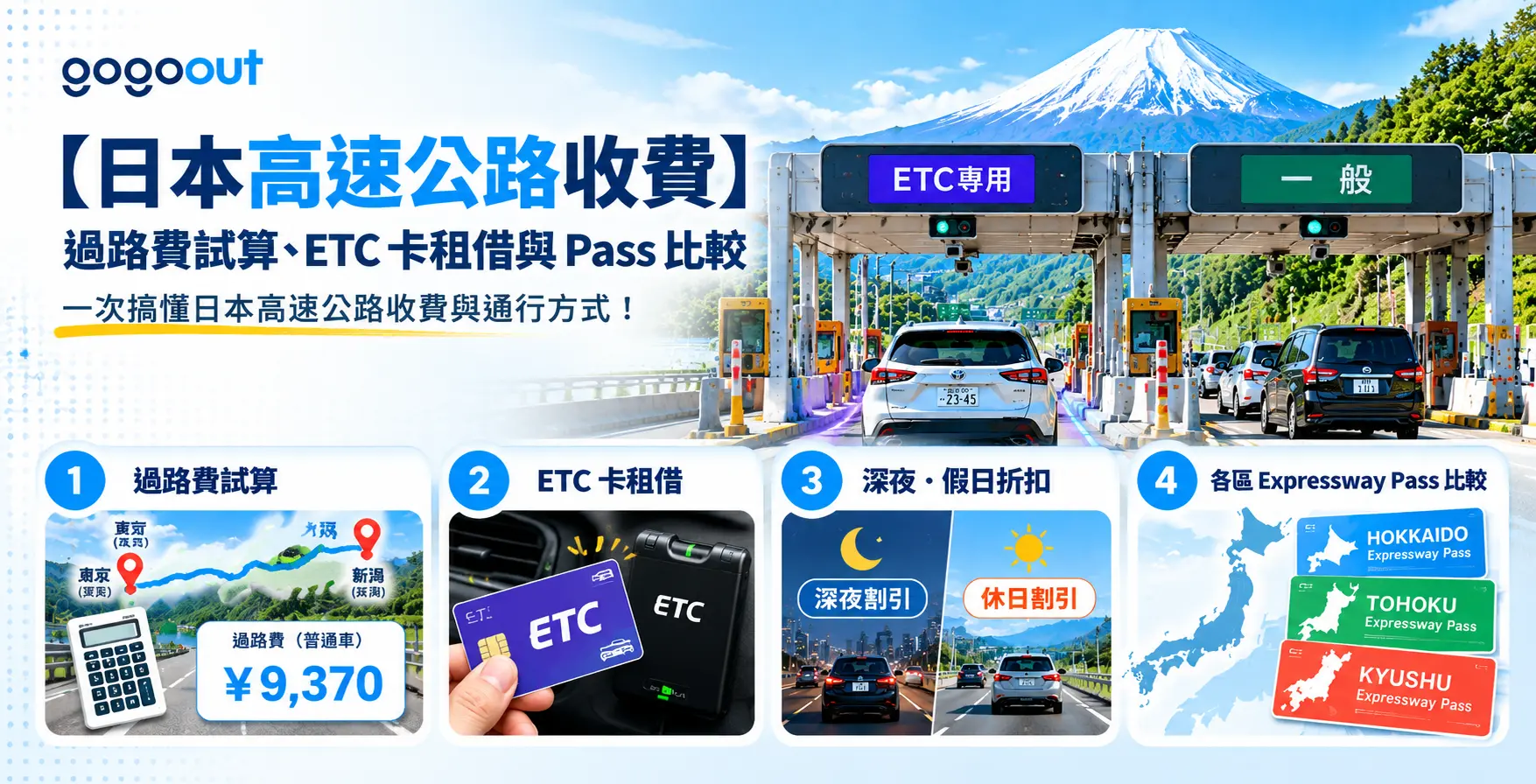
Planning a self-drive trip in Japan — how much should you budget for expressway tolls? Japan’s expressway tolls are calculated mainly by the road section you drive, the distance, your vehicle class, and any ETC discounts. If you want to know in advance how much Japan’s expressways will cost, the most accurate method is to use NEXCO’s official toll calculator to look up the toll between your entry and exit interchanges.
If you just need a rough travel budget, you can also use the gogoout Japan expressway toll calculator in this article to estimate the total cost of a multi-leg trip and compare whether using a regular ETC card or buying an Expressway Pass works out cheaper.
This article covers Japan’s expressway toll structure, toll lookup tools, the ETC card rental process, late-night and holiday discounts, rules for passing through toll gates, and when regional Expressway Passes for areas like Hokkaido and Kyushu make sense — so first-time self-drive travelers in Japan can plan their expressway budget with confidence.
內容目錄
Are Japan’s expressway tolls expensive? Toll structure and vehicle classes
Japan’s expressways (高速道路, “kosoku doro”) are mostly run on a user-pays system, managed primarily by expressway companies such as NEXCO East, NEXCO Central, and NEXCO West, while some urban expressways are operated by companies like Shuto Expressway and Hanshin Expressway.
Compared with Taiwan’s expressway toll system, tolls on some long-distance routes in Japan can be relatively high, especially when you cross several regions, and tolls can become a significant expense on a self-drive trip.
That said, Japan does not use a single nationwide toll formula — the actual cost depends on the road and the vehicle class.
1. The three components of a Japanese expressway toll
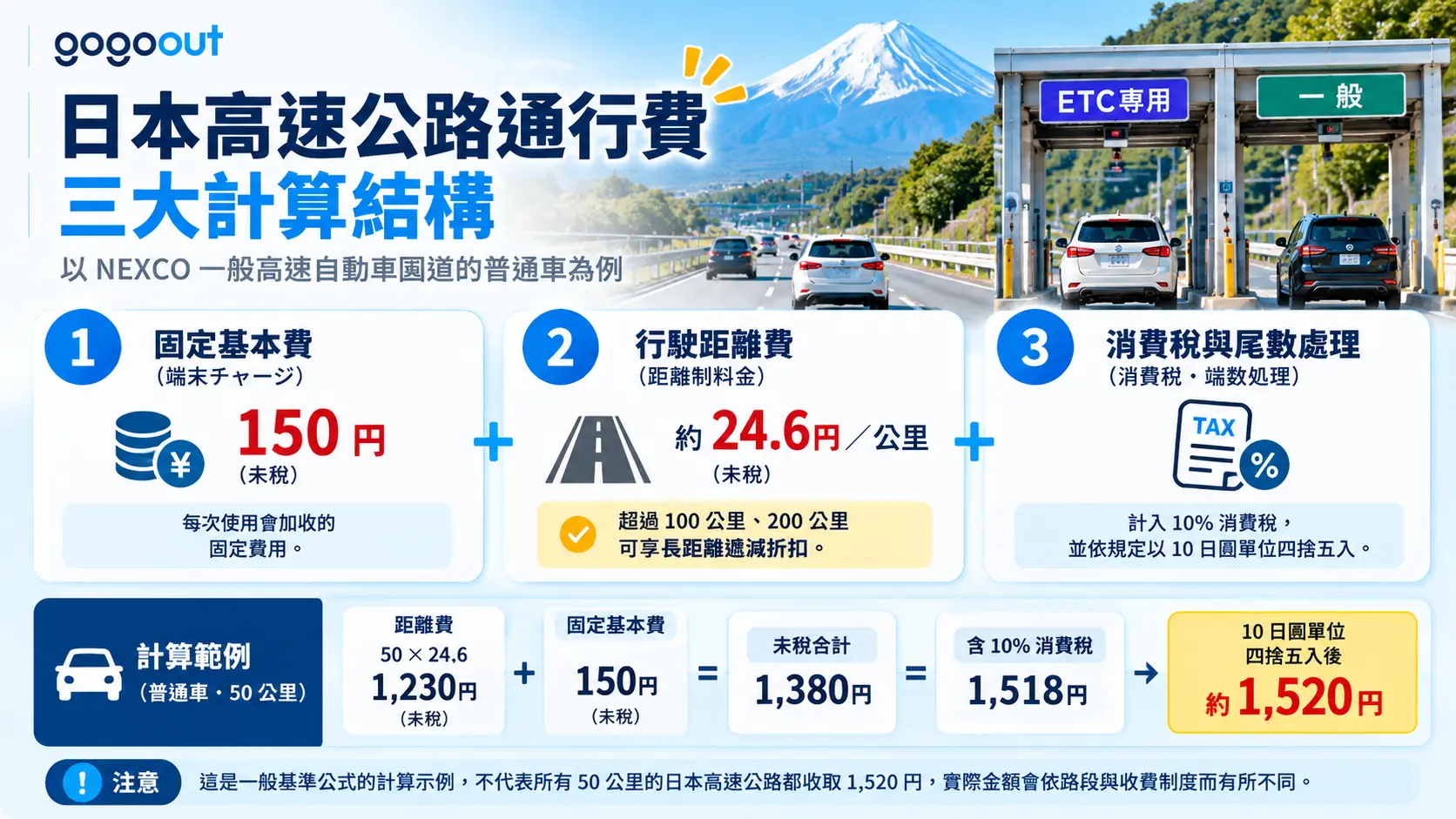
Taking the basic toll for a standard car on NEXCO’s general national expressways as an example, the main components are as follows:
① Fixed base charge (端末チャージ, terminal charge)
Under some general expressway toll formulas, a fixed base charge of 150 yen (before tax) is added each time you use the road. This applies to specific toll systems and cannot be applied directly to every toll road in Japan.
② Distance charge (距離制料金, distance-based toll)
On ordinary sections, the standard rate for a standard car is about 24.6 yen per kilometer (before tax), while some sections near major cities or special sections use different rates. In addition, on roads covered by the long-distance tapering system, the portions of a trip beyond 100 kilometers and 200 kilometers receive a long-distance discount.
③ Consumption tax and rounding
After the base charge and distance charge are calculated under the applicable toll system, Japan’s consumption tax is added and the final figure is rounded according to the rules. Here is an example for a standard car driving a 50-kilometer section at the general standard rate:
- Distance charge: 50 × 24.6 = 1,230 yen
- Fixed base charge: 150 yen
- Subtotal before tax: 1,380 yen
- Including 10% consumption tax: 1,518 yen
- Rounded to the nearest 10 yen, the example amount comes to about 1,520 yen
Note: this is only an example based on the general standard formula, and it does not mean every 50-kilometer stretch of Japanese expressway costs 1,520 yen. The Shuto Expressway, Hanshin Expressway, flat-rate roads, special sections, and sections with ETC discounts may all follow different rules.
2. Vehicle classes and rate differences on Japan’s expressways
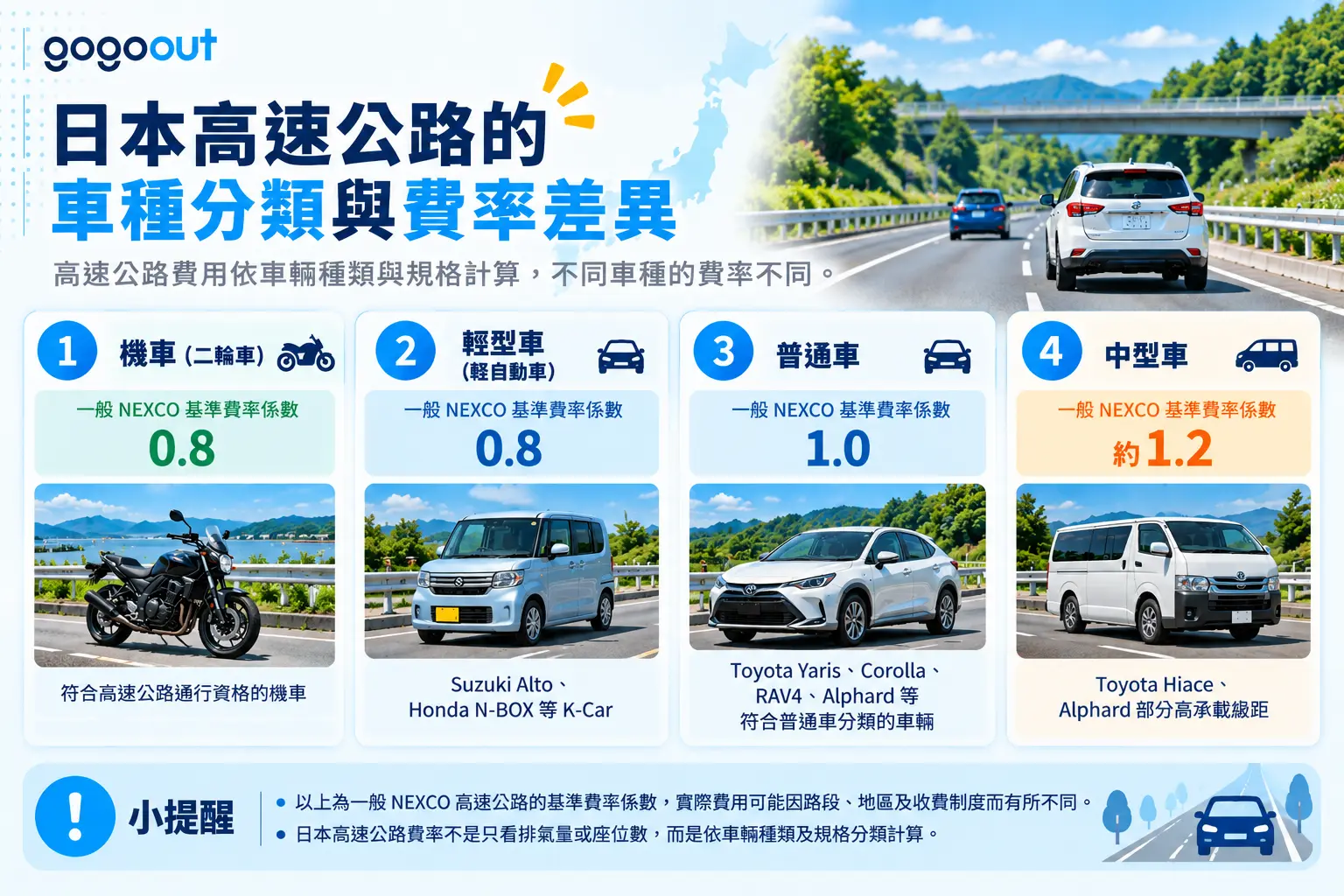
Japan’s expressways set different rates by vehicle type and specification, not just by engine displacement or seat count. For most self-drive travelers in Japan, these are the classes you will come across most often:
| Vehicle class | Common vehicles | General NEXCO standard rate multiplier |
|---|---|---|
| Motorcycle (two-wheeler) | Motorcycles eligible to use expressways | 0.8 |
| Kei car (軽自動車, light vehicle) | Kei cars such as the Suzuki Alto and Honda N-BOX | 0.8 |
| Standard car | Vehicles classified as standard cars, such as the Toyota Yaris, Corolla, RAV4, and Alphard | 1.0 |
| Medium-size vehicle | Toyota Hiace, and certain higher-capacity Alphard grades | About 1.2 |
Under NEXCO’s general toll classification, motorcycles eligible to use expressways and kei cars both fall under the 軽自動車等 (kei vehicles and equivalent) category and usually pay the same toll bracket.
One important point: motorcycles with an engine displacement of 125cc or less are not allowed on Japan’s national expressways or motor-vehicle-only roads. Some ordinary toll roads may have different rules, so always follow the actual road signs and restrictions.
Also, a large van is not automatically a medium-size vehicle. Ordinary passenger vehicles such as the Toyota Alphard cannot be placed in a higher toll bracket based on their looks or passenger count alone, while special trucks, commercial vehicles, and multi-seat vehicles are classified according to their registered specifications.
3. Reference tolls for popular self-drive routes in Japan
Here is a summary of some expressway trips travelers often make, to give you a first idea of transportation costs.
| Expressway route | Reference one-way toll for a standard car |
|---|---|
| New Chitose Airport → Sapporo-kita IC | About ¥1,430 |
| New Chitose Airport → Otaru | About ¥2,250 |
| New Chitose Airport → Asahikawa-Takasu IC | About ¥4,810 |
| New Chitose Airport → Onumakoen IC (toward Hakodate) | About ¥5,530 |
The figures above come from the standard-fare comparison examples published by NEXCO East for the Hokkaido Expressway Pass, and do not cover every date, discount condition, or alternative route.
As for routes like Narita Airport to Shinjuku, Fukuoka Airport to Yufuin, or Naha to the Churaumi Aquarium, different entrances, exits, and expressways may be used, so it is best to confirm the interchanges you will actually enter and exit from, then look up the toll with an official calculator.
Tools for looking up and estimating Japan expressway tolls
When planning a self-drive route in Japan, it helps to estimate in advance which expressways you will use each day and roughly how much they will cost.
To check the toll between two specific interchanges, use Japan’s official expressway tools; to work out the expressway budget for your whole trip, try the gogoout toll calculator.
Tool 1: NEXCO’s official DrivePlaza (ドラぷら)
DrivePlaza is NEXCO East’s expressway route and toll lookup service, where you can check expressway routes across regions along with their tolls.
How to look it up:
- Go to the expressway toll and route search function on DrivePlaza.
- Enter your departure interchange (出発 IC) and arrival interchange (到着 IC). If you aren’t sure of the interchange name, switch to the map search and click it directly.
- Choose your departure date, your planned departure or arrival time, and your vehicle class (standard car / kei car).
- Check the driving distance, estimated time and toll for the different expressway routes.
- Confirm the regular toll, the ETC toll and the final price after any discounts you qualify for.
Note: the size of the ETC discount depends on when you drive and which sections you use. Even with the same entry and exit interchanges, the cost can differ by date or time of day. If you don’t know the Japanese name of an interchange, look up your planned route on Google Maps first and then find the matching expressway entrance and exit.
Tool 2: NAVITIME driving route search
NAVITIME offers Japan maps, driving routes and traffic information, and some of its car navigation features show expressway routes along with tolls. Compared with searches that require you to enter interchange names, NAVITIME’s advantage is that you can plan a driving route using a place, facility or address.
It supports a full Traditional Chinese interface, so you only need to enter the name of an attraction or hotel (for example, from New Chitose Airport to Farm Tomita) and the system automatically picks the nearest entry and exit interchanges.
When it comes in handy:
- You aren’t familiar with Japanese interchange names.
- You want to compare driving times on the expressway versus regular roads.
- You want to know whether getting to an attraction means using a toll road.
- You want to work out the order in which to visit different attractions.
Keep in mind, though, that the languages, displayed information and toll features can differ between NAVITIME versions and services, so go by the interface you actually see.
Tool 3: the gogoout Japan expressway toll calculator
If your Japan self-drive itinerary is already set but you don’t want to calculate tolls day by day, use gogoout’s expressway budget calculator to estimate transportation costs for the whole trip.
The tool offers three common vehicle types:
- Motorcycle: two-wheelers that are allowed on expressways.
- Light vehicle: Japanese kei cars.
- Standard car: regular passenger cars and SUVs that fall into the standard car class.
How to use it:
- Choose your vehicle type
- Add the expressway sections you plan to drive
- Enter the expressway mileage to get a rough estimate based on standard NEXCO rates
- If you’ve already found the official ETC amount, you can enter the one-way toll directly instead
- Set the number of trips you expect to drive and any extra costs
- View the total expressway cost across all sections
The tool also lets you enter an Expressway Pass price plus the cost of sections the pass doesn’t cover, so you can compare the budget for using a pass versus paying per trip.
Reminder: mileage mode gives a rough travel budget only; it doesn’t automatically recognize the Shuto Expressway, the Hanshin Expressway, late-night discounts or special toll roads. If you’ve already found the toll on an official website, choose the “known cost” mode for a budget that’s closer to reality.
gogoout | Japan expressway toll and pass budget calculator
Enter your own itinerary and costs: use “mileage estimate” for a ballpark budget, or type in prices from official sources. No login required, and it doesn’t pull live route data.
2. On NEXCO roads, motorcycles and light vehicles usually fall into the same 軽自動車等 (kei vehicles and similar) toll class.
3. Mileage estimates follow NEXCO standard section rates (¥24.6/km, ¥150 fixed charge, long-distance taper, 10% tax).
4. Not suitable for direct use with the Shuto Expressway, Hanshin Expressway, other urban expressways, special sections, flat-rate sections or special cross-operator settlements. Use “known cost” mode instead.
① Create your route sections
Add as many as you need② Is an Expressway Pass worth it?
③ Cost estimate results
If you already have the discounted official price, enter it using “known cost” mode. For routes, rates and pass conditions, go by the expressway operators’ announcements and your rental company’s information.
Handy tips for estimating tolls before you drive
When planning a self-drive trip in Japan, you can also use the “avoid tolls” option in Google Maps to estimate the difference in driving time between regular roads and the expressway. For example, two routes might compare like this:
| Route | Estimated driving time | Toll |
|---|---|---|
| Expressway | 50 minutes | ¥1,500 |
| Regular roads | 1 hour 10 minutes | ¥0 |
If you only save 20 minutes, whether ¥1,500 is worth paying comes down to how your day is planned.
If you need to catch a flight, cover a long distance or avoid mountain roads, or if you have to return the car before a set time, taking the expressway is usually the safer bet. If your schedule is relaxed, you can also take the regular roads and enjoy the scenery.
What is ETC for car rental in Japan? How to rent and use an ETC card
Unlike Taiwan’s familiar eTag system, Japan’s ETC (Electronic Toll Collection) uses a physical IC card that you insert into the car’s ETC on-board unit, which then communicates wirelessly to pay the toll as you pass through a dedicated lane.
1. What’s the difference between an ETC on-board unit and an ETC card?
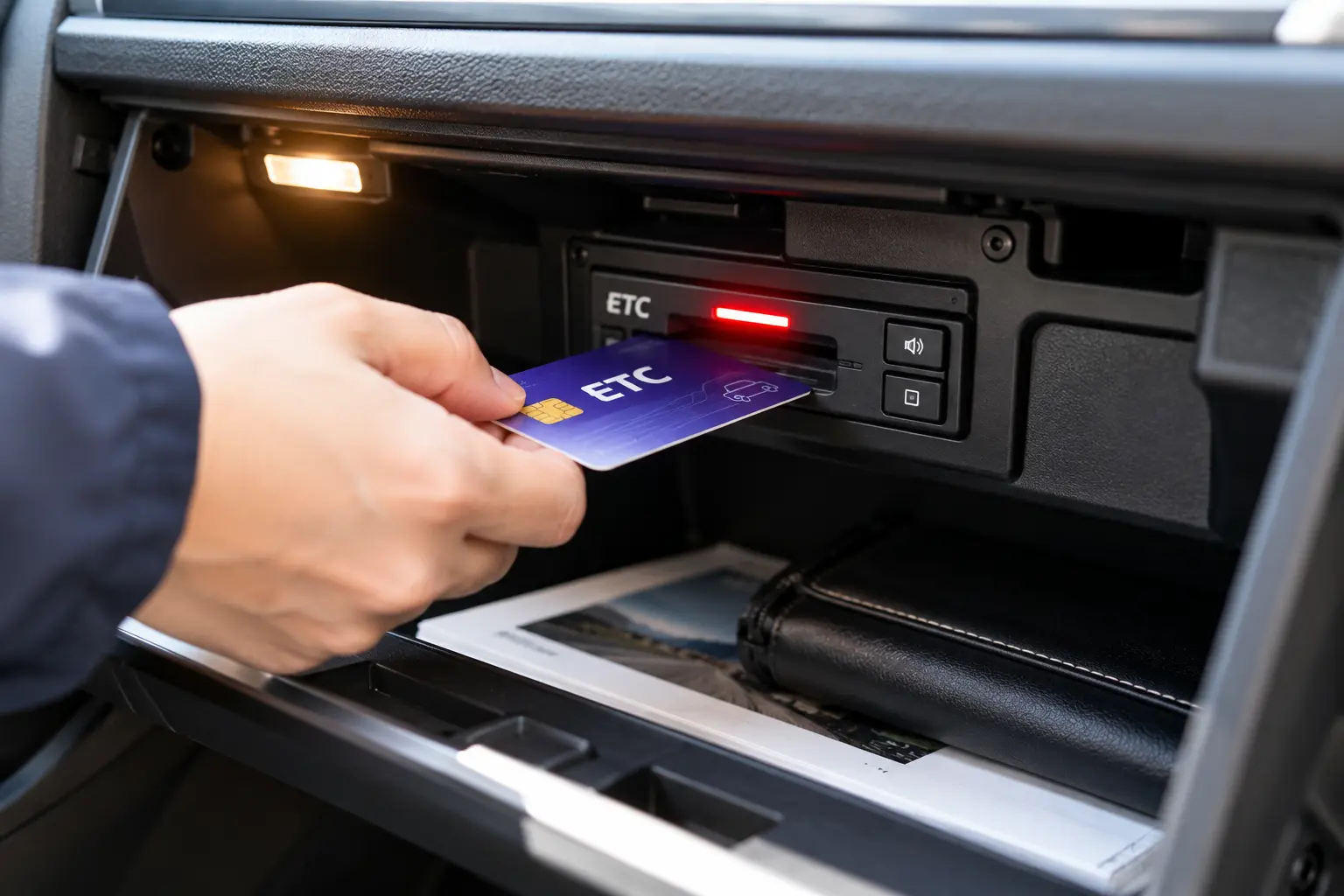
- ETC on-board unit: the card reader installed inside the car (usually in the passenger-side glove box or under the steering wheel). On almost all of the Japanese rental cars offered by partners on gogoout Japan car rental, the on-board unit is standard equipment at no extra charge.
- ETC card: the dedicated IC card that goes into the on-board unit. This card must be rented separately from the rental branch when you pick up the car, and the rental handling fee is usually ¥330 (tax included) per card, per rental.
| Item | ETC on-board unit | ETC card |
|---|---|---|
| Function | Communicates with expressway toll equipment | Used to pay by ETC |
| Location | Installed in the car | Inserted into the on-board unit |
| Confirmation needed? | Yes | Yes |
| Rental cost | Depends on the shop and the car package | As announced by the shop |
When you book, it’s a good idea to confirm whether the car comes with an ETC on-board unit and whether the shop rents out ETC cards.
2. How much does an ETC card cost with a rental car in Japan?
There is no single nationwide price for renting an ETC card. Different rental shops may charge per rental or per day, may provide it for free, or may require it to be paired with a specific expressway pass.
Also, the ETC card rental fee is not the same as the actual expressway tolls. For example:
- ETC card rental fee: calculated according to the rental shop’s plan
- Expressway tolls: calculated based on the routes you actually use and any applicable discounts
- Expressway Pass: if purchased, charged as a flat fee according to the product’s rules
Before booking, check whether these fees are charged separately so there are no misunderstandings when you return the car.
3. How do you check that the ETC card works at pickup?
After you receive the ETC card at the rental counter, you can ask the staff to help you locate the on-board unit and show you how to use the card.
Before setting off, we recommend running through these steps:
- Confirm that the car has an ETC on-board unit installed
- Push the ETC card into the on-board unit’s slot, following the arrow direction and chip orientation, until it clicks into place
- Check the indicator light: a green light plus the voice prompt “ETC カードが挿入されました” (the ETC card has been inserted) means it has been recognized. If you see a red light or hear a warning beep, double-check that the card isn’t inserted the wrong way around.
- If you’re unsure, ask the rental shop to check before you hit the road
Different brands of ETC on-board units may use different lights and voice prompts, so a green light alone isn’t the only thing to go by.
4. How are ETC tolls settled with a rental car in Japan?
When you return the car, the staff will take the ETC card out of the on-board unit and insert it into a dedicated reader to pull up your records. The computer prints out a 「利用明細表(利用証明書)」 (usage statement / usage certificate) listing every interchange you entered and exited, the times and the amounts charged, and you simply settle the tolls on the spot in cash or by credit card.
If you used an Expressway Pass, also confirm which tolls are covered by the pass and whether any extra charges apply for sections it doesn’t cover.
5. How do Japan’s ETC discounts work? Late-night, holiday and excluded dates
Some expressways in Japan offer ETC-only discounts, such as late-night and holiday discounts. But not every expressway offers the same deals, and simply using an ETC card doesn’t automatically get you a discount.
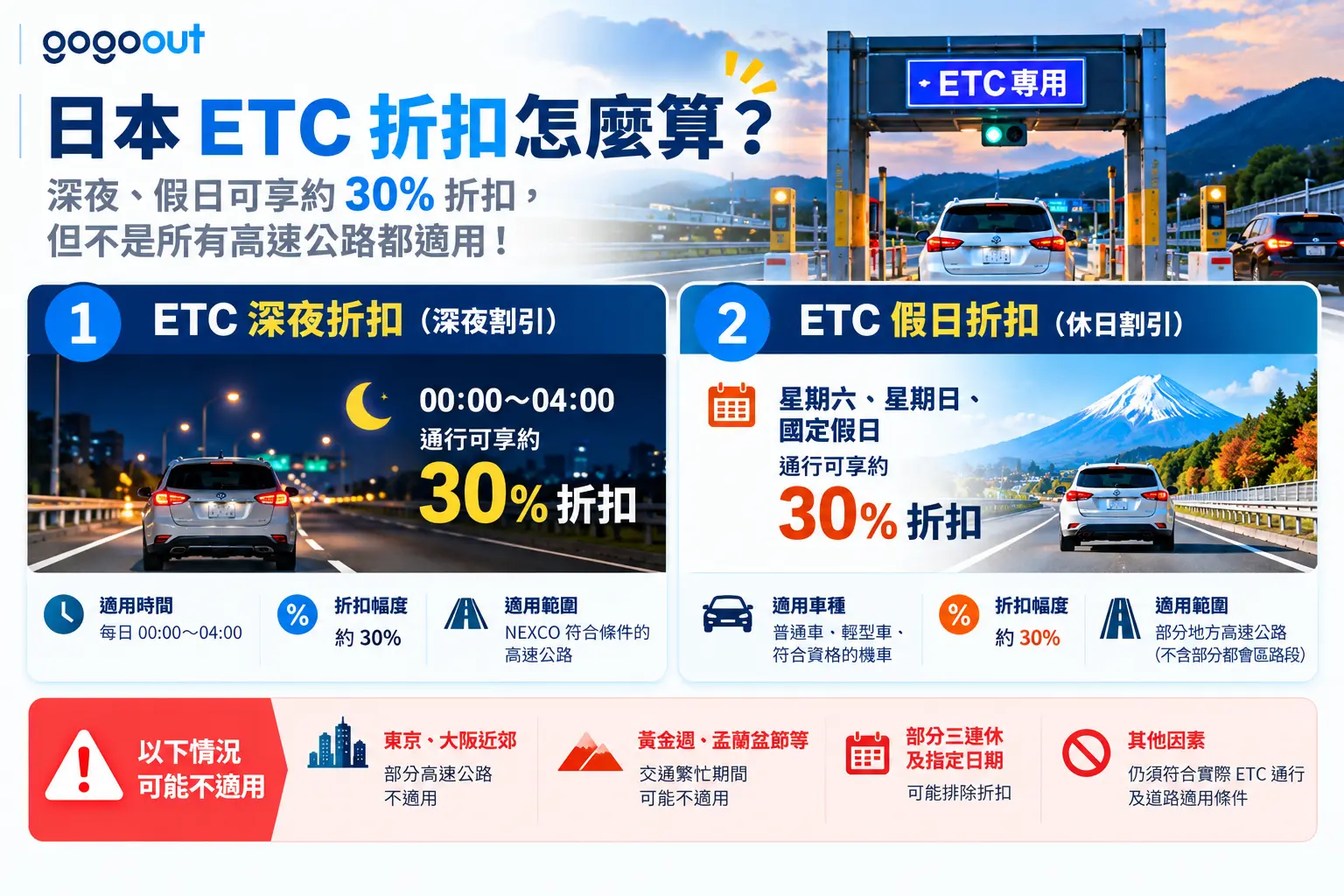
(1) ETC late-night discount (深夜割引 / late-night discount)
Under the system currently in effect, eligible NEXCO expressways offer a discount of about 30% for travel during the applicable window of 00:00–04:00 each day. Some roads and special sections are excluded.
(2) ETC holiday discount (休日割引 / holiday discount)
On some regional expressways in Japan, you can get an ETC holiday discount of about 30% on qualifying Saturdays, Sundays and national holidays. Eligible vehicle types include standard cars, kei cars and qualifying motorcycles.
However, keep these points in mind:
- Some expressways around Tokyo and Osaka are excluded
- It may not apply during busy travel periods such as Golden Week and Obon
- Certain three-day weekends and designated dates may be excluded from the discount
- You still need to meet the actual ETC travel and road eligibility conditions
So when planning a self-drive trip on a weekend or holiday, use the official toll calculator and search by your actual travel dates rather than assuming every Saturday and Sunday comes with 30% off.
(3) Can ETC discounts be combined?
The late-night discount, holiday discount and other deals each have their own conditions, and not all of them simply stack. For example, if a toll is ¥3,000 at full price, meeting both the late-night and holiday conditions doesn’t mean you get 30% off twice in a row.
Always go by the discount rules the expressway operator actually applies and by your search results. If you’re budgeting for a whole trip, enter the post-discount ETC amount from the official search to avoid double-counting the savings.
How do Japan’s expressway toll gates work? ETC vs. general lanes
As you approach a toll gate on a Japanese expressway, check the signs for ETC, general and shared lanes in advance. If your car doesn’t have a valid ETC card, never drive into an ETC-only lane.
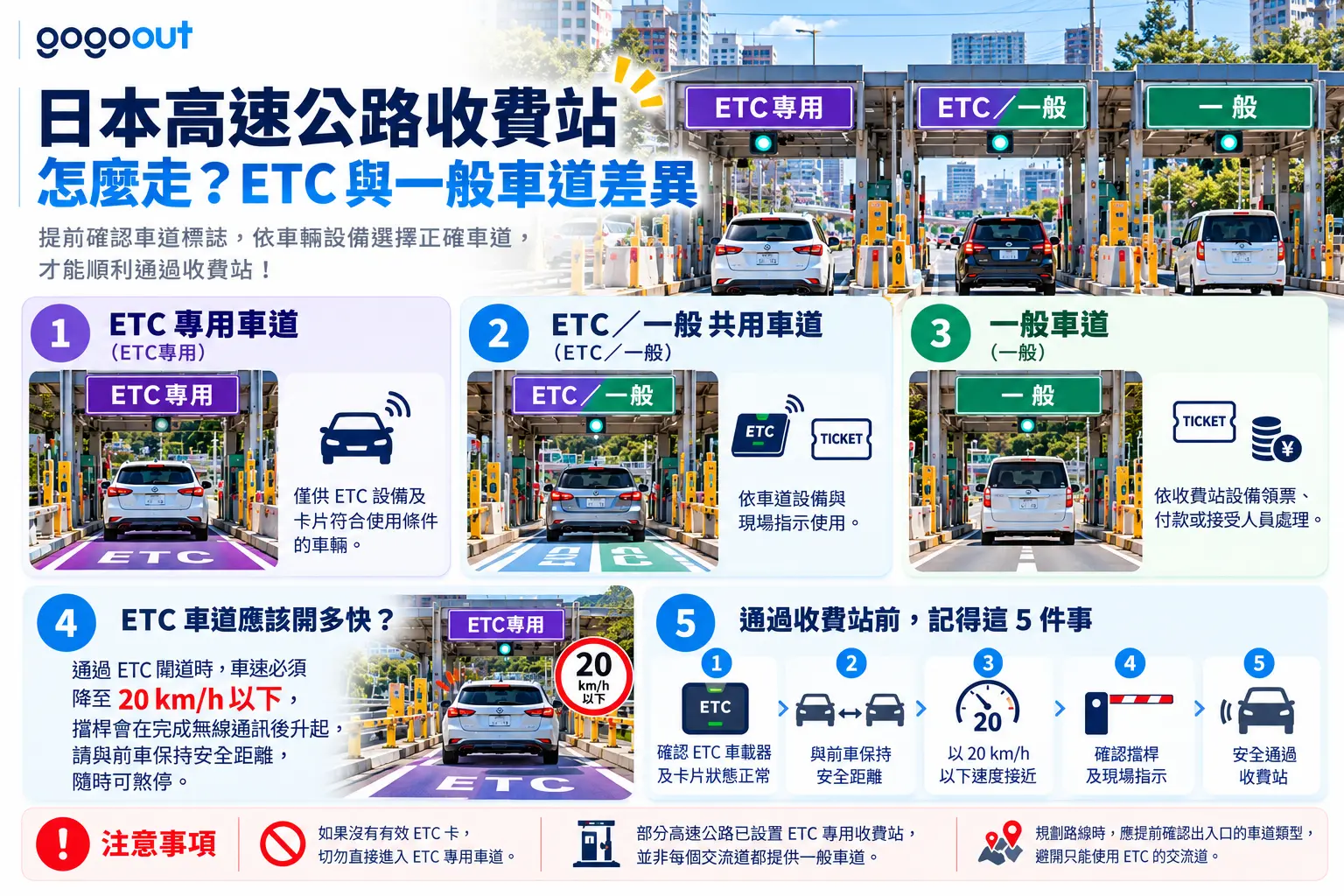
1. ETC-only, general, and shared lanes
| Lane type | Japanese sign | How to use it |
|---|---|---|
| ETC only | ETC専用 (ETC only, purple sign) | Only for vehicles whose ETC device and card meet the requirements |
| General lane | 一般 (general, green sign) | Take a ticket, pay, or have staff process it, depending on the toll booth equipment |
| ETC / general shared | ETC/一般 (ETC / general) | Use according to the lane equipment and on-site instructions |
Equipment varies from one toll booth to another, so always follow the signs and guidance on site. Some expressways now have ETC-only toll booths, and not every interchange offers a staffed general lane.
If you don’t have an ETC card, plan your route ahead of time so you avoid entrances and exits that only accept ETC.
2. How fast should you drive through an ETC lane?
The barrier in a Japanese ETC lane normally stays down and only lifts once your car approaches and the wireless communication is complete. That’s why the rules require you to slow to under 20 km/h when passing through an ETC gate and to keep enough distance from the car ahead that you can stop at any moment. Never speed through the gate.
Before you enter, remember to:
- Check that the ETC device and card are working properly
- Keep a safe distance from the car ahead
- Approach at under 20 km/h
- Watch the barrier and the on-site instructions
- Pass through the toll booth safely
3. What if you enter an ETC-only lane by mistake?
The most common surprise for first-time self-drivers is entering an ETC-only lane without a card inserted, or having the barrier fail to read the card and stay down. If this happens, stay calm and follow the steps below. We also recommend reading our things to know about self-driving in Japan before your trip:
- Never reverse or turn around: cars can come up behind the toll booth at any time, so backing up is very dangerous and can easily cause a rear-end collision. Make sure your insurance is fully covered before you set off — see our guide to Japan car rental insurance (CDW and NOC)
- Turn on your hazard lights and stop in front of the barrier: calmly press the brake and stop the car inside the gate
- Press the help button next to the toll machine (インターホン / intercom): every gate machine has an intercom button. Press it and explain the situation to the staff (if you don’t speak Japanese, simple English such as “Car rental, no ETC card” or “ETC error” works fine)
- Follow the staff’s instructions: a toll attendant will come out from the office to help, or guide you over the intercom to take a slip from the machine so you can pay later. Once you have the slip and pass through, hand it to the attendant in the 一般 (general) staffed lane at the next exit and pay the toll there
Don’t force your way through the barrier, and don’t assume every toll booth lets you pay at the next exit. Expressway operators and toll booths can have different procedures, so always follow the instructions of the staff on site.
Is a Japan Expressway Pass (unlimited ETC tolls) worth it? A roundup of the regional Expressway Passes
Some regions in Japan offer an Expressway Pass that lets eligible foreign travelers use the expressways in a specific area during a set period. These passes usually come at a flat price, but that doesn’t mean you can use every expressway in Japan without limits.
The three most important things to check before buying are the coverage area, the dates of use, and whether your rental company offers the pass.
1. Hokkaido Expressway Pass (HEP)
Hokkaido is vast, and driving from New Chitose Airport to Sapporo, Asahikawa, or Hakodate often means using the expressway. HEP suits travelers planning a long self-drive trip around Hokkaido who expect to use the designated expressways repeatedly.
Here is the official standard-car plan:
| Days of use | Reference price |
|---|---|
| 4 days | ¥7,700 |
| 5 days | ¥9,600 |
| 6 days | ¥11,600 |
| 7 days | ¥13,500 |
| 8 days | ¥15,400 |
HEP comes with eligibility requirements, covered sections, and a list of participating rental companies, and you have to apply through a rental company that offers it. For details, check the official Hokkaido Expressway Pass website.
2. Tohoku Expressway Pass (TEP)
TEP originally offered flat-rate tolls on designated expressways in the Tohoku region, covering Aomori, Iwate, Akita, Miyagi, Yamagata, and Fukushima. However, NEXCO East Japan’s official page currently states that TEP applications are only accepted for use starting on or before September 30, 2026.
So for departure dates from October 2026 onward, you shouldn’t count on TEP as an add-on you can definitely buy. If the pass is reopened in the future, go by the latest official announcements and the information your rental company provides.
3. Kyushu Expressway Pass (KEP)
Kyushu is one of Japan’s most popular self-drive regions, and it’s especially good for multi-prefecture itineraries taking in Fukuoka, Kumamoto, Beppu, Yufuin, and Kagoshima. KEP is offered by NEXCO West Japan and lets you use designated Kyushu expressways as long as you meet the conditions.
Reference prices for the standard-car plan:
| Days of use | Price |
|---|---|
| 2 days | ¥6,200 |
| 3 days | ¥8,400 |
| 4 days | ¥10,600 |
| 5 days | ¥12,800 |
| 7 days | ¥17,200 |
| 10 days | ¥23,800 |
Important update: KEP has officially announced that sales and use will end on March 31, 2027.
If you’re planning a Kyushu self-drive trip in spring 2027, be sure to check whether you can still apply. Note too that KEP does not cover every toll road in Kyushu, such as the Fukuoka Urban Expressway and the Kitakyushu Urban Expressway. You may still have to pay separately for sections that aren’t included.
4. San’in-Setouchi-Shikoku Expressway Pass (SEP)
SEP (San’in-Setouchi-Shikoku Expressway Pass) offers a flat-rate plan for designated expressways in the San’in, Setouchi and Shikoku regions. It suits long self-drive trips covering Hiroshima, Okayama, Yamaguchi, Shimane and Tottori, plus Kagawa, Ehime, Kochi and Tokushima in Shikoku.
Reference prices are as follows:
| Days of use | Price |
|---|---|
| 3 days | ¥10,700 |
| 4 days | ¥11,700 |
| 5 days | ¥12,700 |
| 7 days | ¥14,700 |
| 10 days | ¥17,700 |
However, SEP does not cover every cross-sea road between Honshu and Shikoku; some Honshu-Shikoku connecting expressways and urban expressways are charged separately.
5. Is there an expressway pass for Okinawa?
Okinawa has only one expressway island-wide, the Okinawa Expressway (Kyoda to Naha), and no prefecture-wide expressway pass is issued officially. Some rental companies may offer their own flat-rate expressway plans, but you need to check with the rental shop whether one is available, how much it costs and what the conditions are.
Since the one-way toll for the entire Okinawa Expressway is only about ¥940–1,040 (ETC rate), if your trip mainly uses surface roads in the south or center of the island, simply renting a regular ETC card and paying as you go is usually a better deal than a flat-rate plan.
It’s a good idea to estimate how many times you’ll actually use the expressway first, then decide whether an extra plan is worth buying.
6. How do you work out whether an expressway pass pays off?
Unlimited-use math: does buying a pass always save money?
Buying an expressway pass isn’t always the cheaper option. The right way to compare is to add up the ETC tolls you would otherwise pay within the pass’s coverage area, then compare that total with the price of the pass
For example, say you’re planning a five-day self-drive trip in Hokkaido with the following expressway legs:
| Route | Assumed ETC toll |
|---|---|
| New Chitose → Asahikawa | ¥4,810 |
| Asahikawa → toward Otaru | ¥4,000 |
| Otaru → New Chitose | ¥2,250 |
| Total | ¥11,060 |
If we assume all three legs qualify for HEP, and the five-day HEP costs ¥9,600:
- Without a pass: ¥11,060
- With a pass: ¥9,600
- Estimated savings: ¥1,460
But if you stay in the same place for two of those days and don’t use the expressway at all, paying per trip may well work out cheaper.
You can use the gogoout toll calculator to estimate the cost of your whole route first, then enter the pass price and the tolls for sections it doesn’t cover to see which option fits your actual itinerary better.
Japanese expressway SAs and PAs, plus driving tips
Japanese expressways usually have service areas (SA) and parking areas (PA) along the way, giving drivers a place to rest on long journeys.
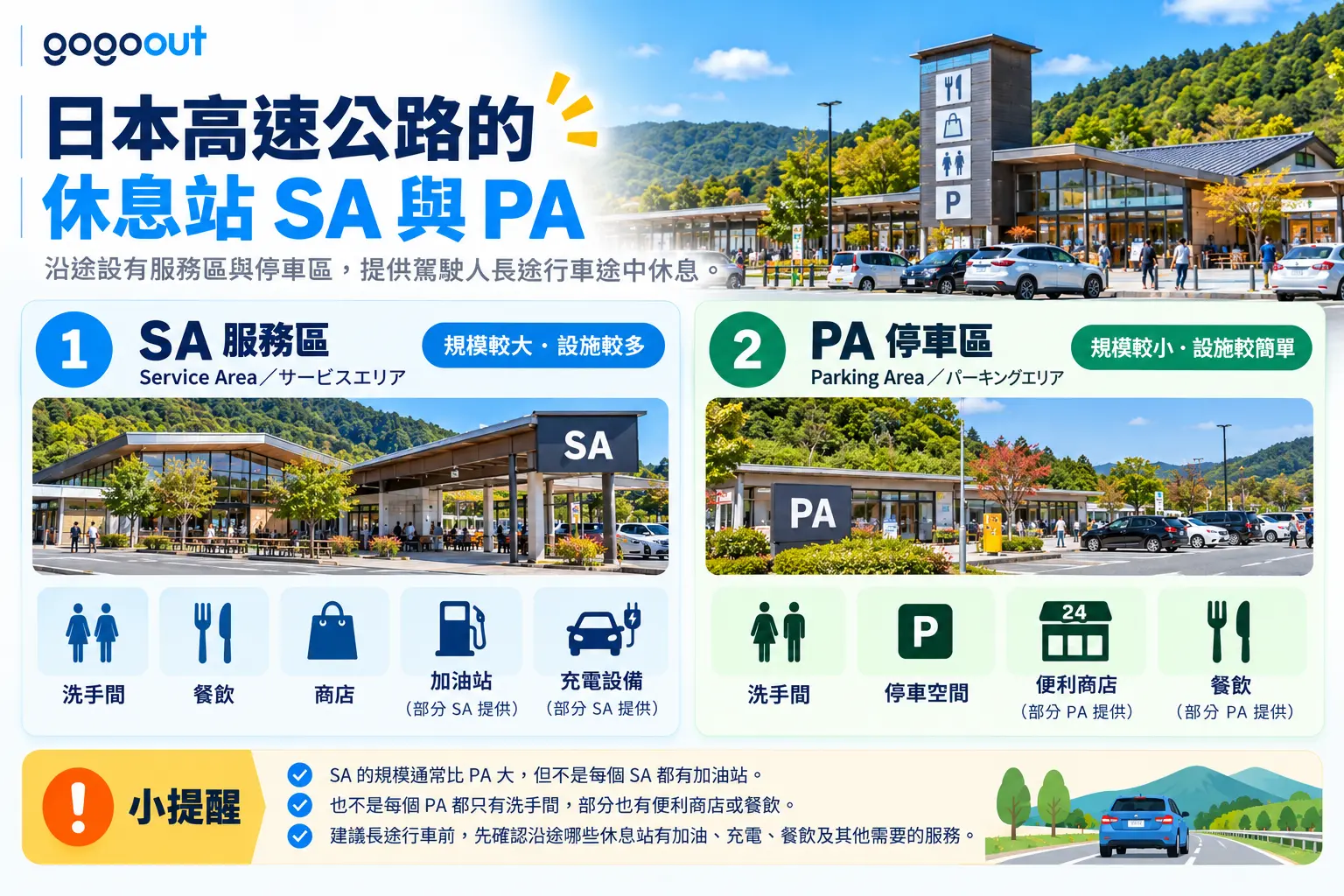
1. What’s the difference between an SA and a PA?
| Type | Japanese | Common facilities |
|---|---|---|
| SA | Service Area/サービスエリア | Restrooms, dining and shops; some have gas stations and EV charging |
| PA | Parking Area/パーキングエリア | Restrooms and parking; some have convenience stores and dining |
Generally speaking, an SA is larger than a PA, but not every SA has a gas station and not every PA has only restrooms. Before a long drive, check which rest stops along your route offer fuel, charging, food and any other services you need.
2. Can you fill up at expressway rest stops?
Some SAs have gas stations, but you should still check their opening hours and services. If you’re planning to drive in Hokkaido, Tohoku or along other long expressway routes, don’t wait until the tank is nearly empty to look for a gas station.
If you’re renting an electric vehicle, check charging station locations, connector types, payment methods and availability in advance as well.
3. Speed limits and driving safety on Japanese expressways
On some of Japan’s national expressways, the legal maximum speed for ordinary passenger cars is 100 km/h, but specific sections may post limits of 80, 70 or 60 km/h, and certain roads allow higher limits where conditions permit.
In rain, snow, heavy fog, roadworks or after an accident, the maximum speed limit may also be lowered temporarily. Follow the on-site signs and electronic message boards, and keep a safe following distance.
Important: on Japanese expressways you drive in the left lane as a rule, moving into the right-hand passing lane only to overtake, then returning to the left lane once you’re done.
FAQ: driving on Japanese expressways
Yes, at entrances and exits that have a regular toll lane open to non-ETC vehicles. However, some interchanges are now ETC-only, and without compatible ETC equipment and a card you can’t use them. Check your route and the types of toll gates before you set off.
Some regular toll gates accept cash or designated credit cards, but payment methods vary from gate to gate. ETC-only entrances and exits can’t be used as cash lanes, so follow the on-site instructions and official rules.
Eligible motorcycles may use Japanese expressways, but motorcycles of 125cc or less are banned from national expressways and motor-vehicle-only roads. Motorcycles and kei cars usually fall under the same 「軽自動車等」 (kei cars and similar) toll category, though you should still check the restrictions for each road.
Not necessarily. ETC’s main benefit is the convenience of passing through toll gates, and some roads offer ETC-only rates or late-night and holiday discounts. Not every section has a discount, though, so compare the ETC and regular tolls for your actual route.
Not necessarily. The current NEXCO late-night discount applies to eligible roads and time windows, and there’s no guarantee that every toll road in Japan offers the same deal. Reforms to the late-night discount system are also planned, so check the official announcements before you travel.
Not always. Some three-day weekends, Golden Week and other peak travel periods are excluded from the holiday discount. Always check the dates NEXCO publishes for that year and the results of your road search.
Do not reverse, make a U-turn or force your way through the barrier. Stop safely as directed on site, contact the toll booth staff using the intercom or another designated method, and follow their instructions to complete the payment.
Not necessarily. If your itinerary involves several long drives on the designated expressways, a pass may pay off; but if you spend most of your time in the city, stay around one destination, or use a lot of toll roads that aren’t covered, paying per trip with a regular ETC card may be cheaper.
Conclusion: How to budget for Japan expressway tolls
Japanese expressway tolls can be higher than travelers expect, but once you understand how to use an ETC card, how tolls are calculated and what each Expressway Pass covers, it’s much easier to keep your self-drive transportation budget under control.
Before you set off, it’s a good idea to check these five things:
- Estimate your expressway costs first: use DrivePlaza, NAVITIME or the gogoout toll calculator to see roughly how much your whole trip will cost in tolls.
- Confirm the ETC equipment and rental fee: before picking up the car, check whether it has an ETC on-board unit, whether the shop rents out ETC cards, and how the tolls are settled.
- Watch the conditions for ETC discounts: late-night and holiday discounts don’t apply to every road or every date, so don’t simply assume 30% off your total tolls.
- Compare whether a pass is worth buying: add up the ETC tolls on your itinerary that fall within the pass’s coverage, then compare that with the pass price plus the cost of any sections it doesn’t cover.
- Stay safe on the expressway: choose the correct toll lane in advance, observe speed limits and following distances, and never reverse if you miss your exit or enter the wrong toll lane.
If you’re planning a long self-drive trip in Hokkaido, Kyushu or another region of Japan, pin down your sights and accommodation first, then estimate your daily expressway costs to build the transportation budget that suits you best.
Getting ready for a self-drive trip in Japan? Compare car models and rates across Japan on the gogoout car rental platform, and check how each rental shop provides ETC cards and Expressway Passes before you book, so your planning goes smoothly.
This article was translated by AI from the original Chinese version.