
Rent a car in Nagoya and explore this central Japan hub at your own pace! Whether you want to head into the countryside to visit Shirakawa-go in Gifu or cruise along Ise Bay for ocean views, a rental car in Nagoya gives you freedom and convenience.
Compared with the hustle and bustle of Tokyo and Osaka, Nagoya’s roads are more spacious and relaxed, making it a great place for a self-drive trip.
This article is your ultimate guide to renting a car in Nagoya! From the documents you need to prepare, to comparisons of popular rental companies, insurance options and traffic rules, we answer all your questions in one place. Let’s start your Nagoya self-drive adventure!
Nagoya car rental: the most common questions
Q: What documents do I need to rent a car in Nagoya?
A: When renting a car in Nagoya, you need to bring your Taiwanese driver’s license, a Japanese translation of your driver’s license, your passport, and the credit card you used to book. All of these are required—especially the Japanese translation, since Japanese law requires foreign drivers to present an official translation in order to rent a car.
Q: What’s included in the Nagoya car rental fee? How do I choose insurance?
A: Generally, the rental fee you pay online covers the vehicle rental and basic insurance (with a deductible), but not fuel, highway tolls or optional extras such as GPS or a child seat. To reduce your risk, you can add CDW (collision damage waiver) or NOC (non-operation charge) coverage; we explain the difference between the two later in this article.
Q: Is airport pickup available when renting a car in Nagoya?
A: Services vary from shop to shop. Below you’ll find gogoout‘s selection of Nagoya car rental shops, with the highlights of each one explained!
Recommended Nagoya car rental shops
| Nagoya shops | Shop highlights | Special price | Chinese-speaking support | Airport pickup | Basic insurance | Full coverage add-on |
|---|---|---|---|---|---|---|
| E-DRIVE Book now 👉 | Close to Nagoya Station, a 5-minute walk away | From NT$1900 / day | ⭕️ | ✅ | Add insurance on site |
👇👇 Nagoya car rental from NTD 1900 per day 👇👇
Nagoya Station car rental | E-DRIVE
Real customer rating: ★★★★★ 5 stars
🪧 About the shop
E-DRIVE is located right next to Nagoya Station, an extremely convenient spot that is less than a 5-minute walk from Exit E4, so you can finish the paperwork quickly and set off on your Nagoya self-drive trip. With great prices and thoughtful Chinese-language service plus a professional rental process, the shop earns high marks from travelers from Taiwan and around the world, and has become a top choice for driving around Nagoya and the surrounding region.
For extra peace of mind on the road, E-DRIVE offers Japanese car rental insurance on site, so you’re protected throughout the rental period and can enjoy a worry-free trip.
📢 Highlights
Next to Nagoya Station, pick up your car within a 5-minute walk:
E-DRIVE’s branch is only a 5-minute walk from Nagoya Station, and you can head straight there from Exit E4 to complete the rental paperwork quickly—no long walks or transfers to other transportation needed, so your itinerary runs smoothly and efficiently.
A wide range of vehicles, from 5-seaters to 8-seaters:
Whether you’re traveling solo, driving as a couple, taking a family trip or need a larger multi-seat van, E-DRIVE has a car to suit you.
Traveler-friendly for visitors from Taiwan, rentals with a Japanese translation of your license accepted:
E-DRIVE is very welcoming to travelers from Taiwan and accepts rentals with a Japanese translation of a Taiwanese driver’s license—no complicated paperwork, so you can get on the road fast. The shop also offers Chinese-language service, and the rental process is simple and clear, making it easy even for first-time drivers in Japan.
Airport branch pickup available, with paid one-way rental:
Besides downtown Nagoya rentals, E-DRIVE also has a pickup point at Nagoya airport; you can arrange airport pickup through customer service for an even smoother rental experience. The shop also offers paid one-way rental, so you can pick up at Nagoya airport and return in downtown Nagoya for a more flexible itinerary.
Nagoya car rental company comparison
Nagoya has several well-known rental companies to choose from, each with slightly different prices, services and vehicle options.
Below is a comparison of costs and services at four major rental companies, based on pickup at Chubu Centrair International Airport and a compact 5-seater (such as a Toyota Corolla), with data updated through March 2025:
Comparison based on a compact 5-seater:
| gogoout | Tabirai | Times CAR RENTAL | ORIX RENT-A-CAR | |
|---|---|---|---|---|
| Airport pickup | Varies by shop | Varies by shop | Varies by branch | Varies by branch |
| Chinese-language service | ⭕️ (Chinese online customer service) | ❌ (English online customer service) | ⭕️ | ❌ (English service) |
| Price (per day) | NTD 1900 | About NTD 2450 | About NTD 1720 | About NTD 2210 |
| GPS | NT100 per use | Varies by shop | ⭕️ | ⭕️ |
| ETC | Varies by shop | Varies by shop | About ¥330 per use | About ¥330/time |
| Child seat | NT400/time | About ¥1100/time | About ¥1100/time | About ¥1100/time |
| Business hours | 8:00~22:00 | (varies by branch) 8:00~20:00 | 9:00~19:00 | 8:00~20:00 |
| CDW coverage | ¥2000/24h, NOC included | Included in the car price | About ¥1100/24h | About ¥1100/24h |
| NOC coverage | – | About ¥660/24h | About ¥1100/24h | About ¥660/24h |
Actual amounts follow what is shown when you book on each company’s official website
Nagoya car rental insurance explained

When you rent a car in Nagoya, insurance is something you can’t overlook!
Under Japan’s Road Traffic Act, every rental vehicle must carry basic liability insurance covering bodily injury (up to about 30 million yen per person), property damage and vehicle damage. This basic insurance usually comes with a deductible, so if an accident happens, the renter has to pay roughly 50,000 to 100,000 yen out of pocket.
To lower your risk, these two optional coverages are worth considering:
1. Collision damage waiver (CDW)
CDW is a common add-on that waives the deductible if the car is damaged in a collision. For example, if you accidentally scrape a roadside guardrail, the basic insurance might require you to pay a 50,000 yen deductible, but with CDW added, the insurance company covers that amount in full.
2. NOC coverage (Non-Operation Charge)
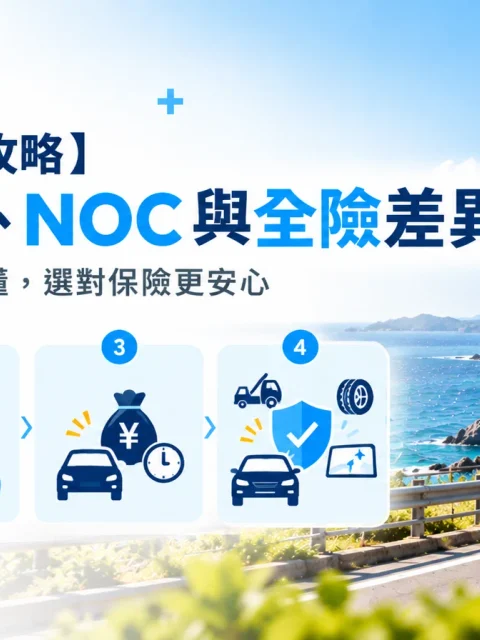
NOC coverage applies to the loss of business income while the car is being repaired after an accident. If the vehicle can’t be used because of an accident, the rental company may charge a “non-operation charge” of 20,000 to 50,000 yen.
Note | It’s worth remembering that CDW and NOC are separate options; you need both for full protection. We recommend confirming exactly what your insurance covers with the staff when you pick up the car, so there are no misunderstandings.
| Coverage | Basic compulsory insurance | Compulsory insurance + CDW | CDW+NOC |
|---|---|---|---|
| Bodily injury compensation (for victims) | ✔️ | ✔️ | ✔️ |
| Property damage compensation | ✔️ | ✔️ | ✔️ |
| Vehicle damage compensation | ✔️ (with deductible) | ✔️ | ✔️ |
| Personal injury compensation (for passengers) | ✔️ | ✔️ | ✔️ |
| Deductible waived | ❌ | ✔️ | ✔️ |
| Non-operation charge waived | ❌ | ❌ | ✔️ |
Documents you need to rent a car in Nagoya
Before renting a car in Nagoya, it’s essential to have these five items ready, or you may not be able to pick up your car:

| Document – Japanese translation of your driver’s license | Under the Geneva Convention on Road Traffic, a Taiwanese driver’s license must be accompanied by a Japanese translation issued by the Motor Vehicles Office to rent a car in Nagoya (the Japanese translation of your driver’s license can be issued at any Motor Vehicles Office; bring your original driver’s license and ID card, plus a NT$100 fee) |
| Document – your home driver’s license | Travelers from Taiwan need to bring a valid Taiwanese driver’s license as proof of identity and eligibility, used together with the Japanese translation of the license |
| Document – passport | The essential ID document when renting a car. Make sure your passport is valid for your entire trip in Nagoya (before entering Japan, make sure it still has at least 6 months of validity) |
| Credit card | You’ll need a credit card in your own name to book and pay. Some branches accept cash, but credit cards are more widely accepted and more convenient |
| Document – rental booking confirmation | After booking online, remember to print or save the confirmation email, including the booking number and pickup location. |
How to book a Nagoya rental car quickly

Step 1: Choose and book your Nagoya car online
Nagoya is a major transportation hub in central Japan, and whether you’re heading to Takayama and Shirakawa-go or exploring the city, driving yourself is the best option. Before booking, it’s a good idea to compare prices, car models and insurance plans across rental companies so you get a car that fits your needs.
The gogoout platform shows detailed vehicle information, including real photos, model specs and user reviews, to help you make the best choice.
Booking online isn’t just convenient, it also lets you choose your pickup location, such as Nagoya Station or Chubu Centrair International Airport, giving your trip far more flexibility!
Step 2: Pick up your car in Nagoya
Head to your chosen rental branch at the time you booked. The main pickup spots in Nagoya include Nagoya Station (Meieki), the Sakae district and Chubu Centrair International Airport, all close to major transportation hubs and easy to reach.
When picking up the car, bring your passport and driver’s license (with the Japanese translation or an International Driving Permit) and sign the rental agreement with the company. Be sure to check the car’s condition, fuel level, ETC card and navigation system carefully, and confirm the return process, return time and any possible extra charges with the rental company so your plans aren’t disrupted.
Step 3: Wrap up your Nagoya rental
When your trip is over, return the car to the agreed branch as stated in your contract, or choose a one-way rental drop-off (extra fees may apply).
At drop-off, you’ll inspect the inside and outside of the car with the staff to confirm there’s no damage, and pay any highway tolls, parking fees or refueling charges.
Confirm the mileage with the rental company’s staff and settle the final bill, including ETC highway tolls.
Renting with gogoout really is that fast!
From compact cars and people carriers to vans, everything you need for a Nagoya car rental in one place.
gogoout shows real photos of the vehicles, detailed specs and user reviews to help you pick the best option. Renting a car in Japan has never been easier!
Nagoya car rental: things to know
1. Traffic rules / traffic fines

Driving on the left with right-hand drive
Japan drives on the left with the steering wheel on the right, the exact opposite of Taiwan, which makes it a real challenge for Taiwanese travelers driving in Japan for the first time. The steering wheel sits on the right side of the car, and the turn signal and wiper stalks may also be reversed from what you are used to (turn signal on the right, wipers on the left).
Turns work the other way around
Turning in Japan follows the “wide right, tight left” principle: a right turn swings wide (like a left turn in Taiwan), while a left turn stays tight (like a right turn in Taiwan). This is because Japanese road design gives priority to keeping oncoming traffic flowing.
For example, at intersections in downtown Nagoya, you need to wait for oncoming and through traffic to clear before turning right, and watch for pedestrians crossing.
See the full guide to Japanese traffic rules:[Japan car rental] 2025 rental guide and price comparison for a free and easy road trip in Japan!

Come to a full stop before proceeding
In Nagoya, if an intersection has a 「止まれ」 (stop) or 「踏切」 (railroad crossing) sign, you must come to a complete stop (wheels still for at least 3 seconds), check both directions and only then move off. This is not just the law, it is also key to avoiding collisions with trains or oncoming cars.
For example, there are plenty of railroad crossings on the outskirts of Nagoya, especially on routes toward Gifu or Mie Prefecture. Ignoring a 「止まれ」 (stop) sign carries a fine of ¥7,000, and failing to stop before a railroad crossing costs ¥9,000, plus demerit points that can affect your license.
Fine for failing to stop: if you do not come to a complete stop before a “止まれ” (stop) sign, you face a ¥7,000 fine.
Fine for not stopping at a railroad crossing: failing to come to a complete stop before a railroad crossing carries a fine of up to ¥9,000.

Stopping briefly at the curb
Japan regulates street parking very strictly, and Nagoya is no exception. A dashed yellow line along the curb means you may stop briefly (for example to drop off or pick up passengers, but you must not switch off the engine and leave the car), while a solid yellow line means parking or stopping is completely prohibited.
If you have to stop at the roadside, pay close attention to the markings along the curb:
Dashed yellow line: brief stops are allowed, but you may not park; the car must stay ready to move.
Solid yellow line: stopping or parking is completely prohibited. Parking here counts as a serious violation.
Illegal parking can lead to fines starting at ¥20,000.
Tip | If you are unlucky enough to get a traffic ticket, remember to pay it at a local police box (koban). If you leave it to the rental company to settle after you return the car, the amount will be higher!

Tip | Watch out for 「月極駐車場」 (monthly rental parking lots). These are reserved for long-term tenants, and if you park there by mistake your car may be clamped, with an unlocking fee starting at around ¥5,000.
How parking lots charge in Nagoya

Parking fees in Nagoya can be complicated, varying by time of day, location and type of lot.
For example, in downtown commercial areas such as Sakae, weekday rates run about ¥200–300 per hour from 8:00 to 20:00, while overnight from 20:00 to 8:00 there may be a cap of ¥800. Here are the common ways fees are broken down:
- By day of the week: a split between weekdays and 土日祝 (Saturdays, Sundays and holidays), or between 月~土 (Monday to Saturday) and 日曜 (Sunday)
- By time of day: daytime 8:00–20:00 / xxx yen, nighttime 20:00–8:00 / xxx yen
- Maximum charge: daytime max xxx yen, nighttime max xxx yen; 入庫から / 駐車後12時間最大 (maximum charge within a set number of hours from entry or after parking)
Each of these rules works differently, and if you only look at the maximum charge you may overlook the fine print next to it and end up paying a hefty parking bill!
Further reading on Japanese parking fee signs: Times parking lot sign / Meitetsu Kyosho parking lot sign
Pedestrians come first

Under Japanese traffic law, pedestrians always have absolute priority. At crosswalks and intersections in Nagoya, drivers must come to a complete stop and let pedestrians cross, even where there is no traffic light!
Consider renting snow tires in winter:
Nagoya gets occasional snowfall in winter (December to February), and roads can be icy or snow-covered, especially on trips into the mountains of Gifu or Nagano. Regular tires do not grip well on snow and can easily slip or send you out of control, so it is worth adding snow tires and checking that the car comes with snow-clearing gear such as a shovel and brush.
Expressways can close during heavy snow in winter, so keep an eye on the NEXCO website for real-time road conditions.
2. Traffic signals

Understanding the traffic lights
Japanese traffic lights have two rows: the top row is the main signal (red, yellow, green) and the bottom row shows directional arrows (straight, left turn, right turn).
For example, a red light with a green straight-ahead arrow means you may only go straight; all other directions must stop.
Red light + straight arrow: you may continue straight ahead, but may not turn.
Red light + left-turn arrow: you may turn left, but may not go straight or turn right.
Green light + right-turn arrow: traffic may proceed safely in all directions, including turning right.
These signals matter a great deal and keep traffic orderly and safe.
Always follow them to protect yourself and everyone else on the road.
Road signs
Below are some of the most common road signs. When driving in Nagoya, keep an eye on the signs so you do not break the law.

See the full guide to Japanese traffic signals:[Japan car rental] 2025 rental guide and price comparison for a free and easy road trip in Japan!
3. Setting up the car navigation system

Car navigation systems in Japan have a unique feature called the Mapcode system, and almost every vehicle in Japan is equipped with it.
You can look up the Mapcode of your destination on Mapion and then enter that number directly into the car’s navigation unit.
You can also simply enter the destination’s phone number, which sometimes gives more accurate directions than Google Maps!
Further reading on setting up Mapcodes in Japan: How do you navigate on a self-drive trip in Japan? An intro to Mapcode
4. Gas stations in Nagoya
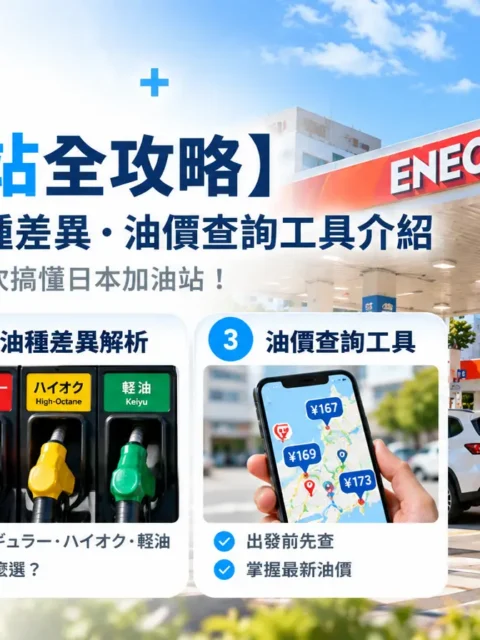
Gas stations in Nagoya come in two types, full-service and self-service, with self-service being more common because it costs less. When you rent, check which fuel your car takes (regular gasoline is the red nozzle 「レギュラー」, premium is the yellow 「ハイオク」, and diesel is the green 「軽油」).
| Fuel type | Nozzle color | Japanese | English |
|---|---|---|---|
| Regular gasoline (95) | Red | レギコラー | Regular |
| Premium gasoline (98) | Yellow | ハイオク | Premium |
| Diesel | Green | 軽油 | Diesel |

Here’s how self-service refueling works:
1. Choose the fuel, amount and payment method:
On the screen, pick the fuel type and decide how much to add (by liter, by amount, or 「満」 (full tank)), then choose credit card, cash, or paying at the counter inside.
2. Refuel:
Open the fuel door, insert the nozzle and squeeze to start fueling. When you’re done, return the nozzle, close the fuel cap tightly, and collect your receipt and change.
Tip | Gas in downtown Nagoya costs roughly 10–20 yen more per liter than in the suburbs. If you’re not comfortable with the machines, choose a full-service station and ask the attendant for help!
Nagoya car rental FAQ
1. How old do you have to be to rent a car in Nagoya?
A: In Nagoya, most rental companies (such as Times and ORIX) require drivers to be at least 20 years old and to have held a driver’s license for at least 1 year. This is to make sure drivers have basic experience and to lower the risk of accidents on a self-drive trip around Nagoya.
2. How are expressway tolls calculated in Nagoya?

A: Japanese expressways have regular lanes (cash payment) and ETC lanes (electronic toll collection), with fees based on distance and vehicle class.
ETC lanes are usually faster, but you’ll need to rent an ETC (electronic toll collection) card (about 330 yen per rental), and when passing through the toll gate you must keep your speed under 20 km/h so the sensor reads the card.
3. What should you do if you have a car accident in Nagoya?
A: Whether it’s a single-vehicle collision or a crash with another car, the first step is to make sure everyone is safe: move the car to the roadside, turn on your hazard lights, then call 110 to report it to the police and contact your rental company right away.
Once the police arrive they will file an accident report. Take photos of the scene (vehicle damage, road conditions, the other car, and so on) and keep the accident certificate so you can file a claim under your Nagoya rental car insurance and start the reimbursement process!
4. How do you pay a traffic ticket you get in Nagoya?

A: In Nagoya you have to pay traffic fines yourself at a prefectural police station (koban) in the area that issued the ticket. The amount depends on the violation (for example, illegal parking starts at 10,000 yen, and speeding runs 10,000–30,000 yen).
If you can’t pay in time, tell the rental company when you return the car and they can pay on your behalf, though they’ll charge an extra handling fee of around 20%–30%.
5. How do you cancel a Nagoya car rental booking?
Most online platforms, including gogoout, allow free cancellation as long as you’ve added the “Cancellation Protection” option. Otherwise you generally need to cancel 5–7 days before pickup, depending on the individual supplier. If you don’t cancel in time, you may be charged the full amount.
Nagoya car rental: final thoughts
Now that you’ve read this complete Nagoya car rental guide, you should have all the key information covered, from booking to drop-off. With its easy access, wealth of attractions and great food, Nagoya is an ideal base for a self-drive trip.
As long as you prepare your documents in advance, pick the right rental company and insurance, and follow local traffic rules, your Nagoya trip will be full of freedom and fun.
Whether you’re visiting historic sites or tucking into grilled eel rice, a rental car gets you to every stop with ease. Get ready to hit the road: Nagoya is waiting for you!
Read more articles about renting a car in Japan:
👉[Okinawa Sports Car Rental] Recommended rentals, price comparisons and a complete guide to a sports car road trip in Okinawa
👉[Okinawa Car Rental Must-Read] Recommended rentals, cost comparisons and self-drive tips in one full guide!
👉[Tokyo Car Rental] Recommended rentals, rental company comparisons and key tips for a Tokyo self-drive trip!
👉[Osaka Car Rental] Rental recommendations, self-drive essentials and an insurance guide, all made easy in one article!
👉[Fukuoka Car Rental] Recommended rentals, company comparisons and a complete Fukuoka self-drive guide!
👉[Hokkaido Car Rental] The latest guide, with 9 must-know tips before you hit the road!
This article was translated by AI from the original Chinese version.