On a trip to Japan, renting a car and driving yourself lets you reach hidden spots that public transport can’t easily get to. Whether you’re cruising the endless Panorama Road in Biei, Hokkaido, taking a relaxed drive along Okinawa’s coastline, or winding through the beautiful Fuji Five Lakes area, it’s a wonderfully freeing experience.
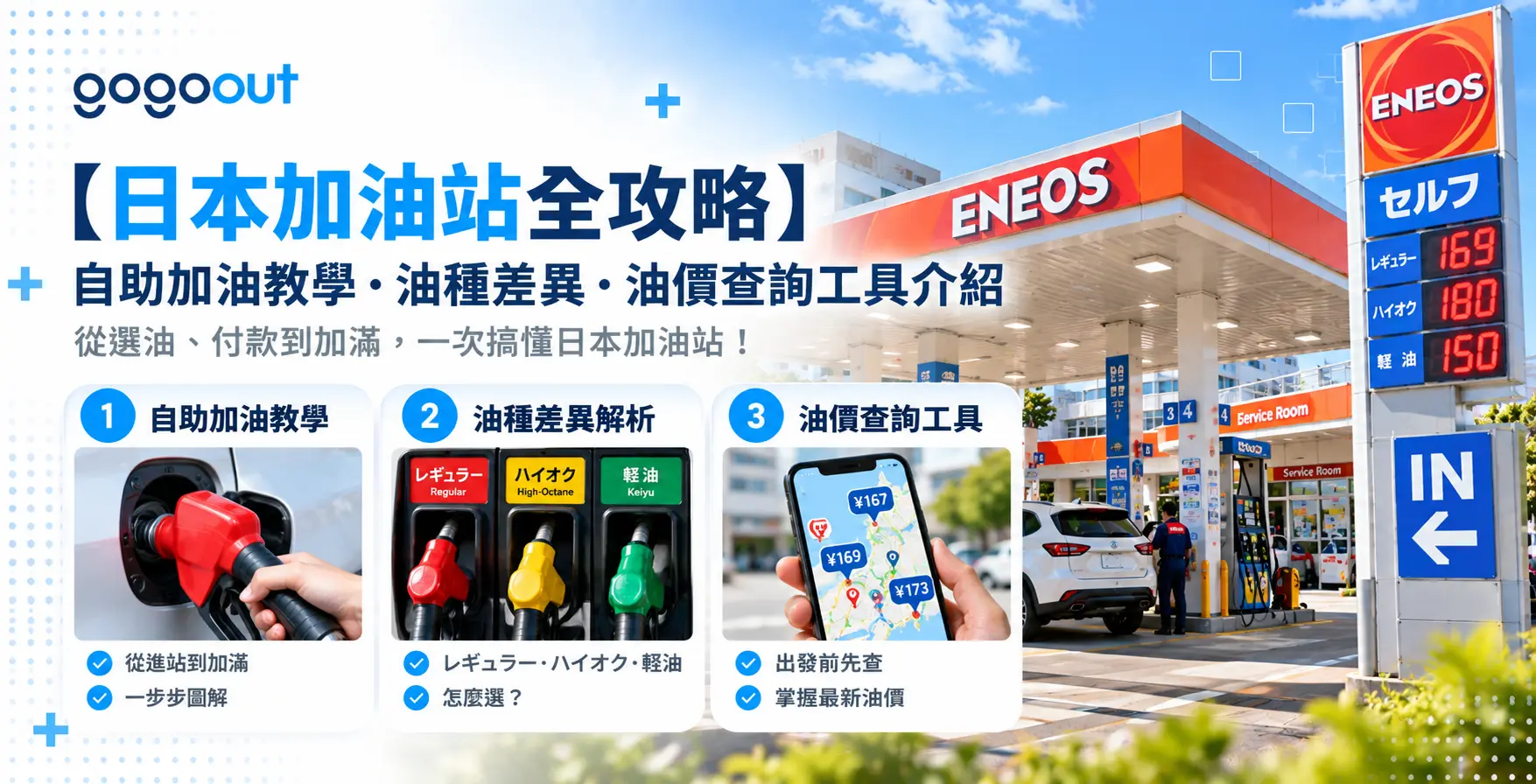
That said, knowing the techniques and rules for refueling on a self-drive trip in Japan is a basic skill every driver heading to Japan should have. Besides reading our complete guide to renting a car in Japan before you go to get the full picture, this article walks you through how Japanese gas stations work, how to identify fuel types by color, the 6 standard steps for self-service refueling, how to use the change machine, and the “return the car with a full tank” receipt rules you can’t ignore when dropping off the car — so you can avoid the costly trap of putting in the wrong fuel and drive with peace of mind.
內容目錄
1. Japanese gas stations explained: full service vs. self service
Gas stations in Japan fall into two main categories: full service and self service. The two differ clearly in the service you get, the price of fuel, and how you operate the pump:
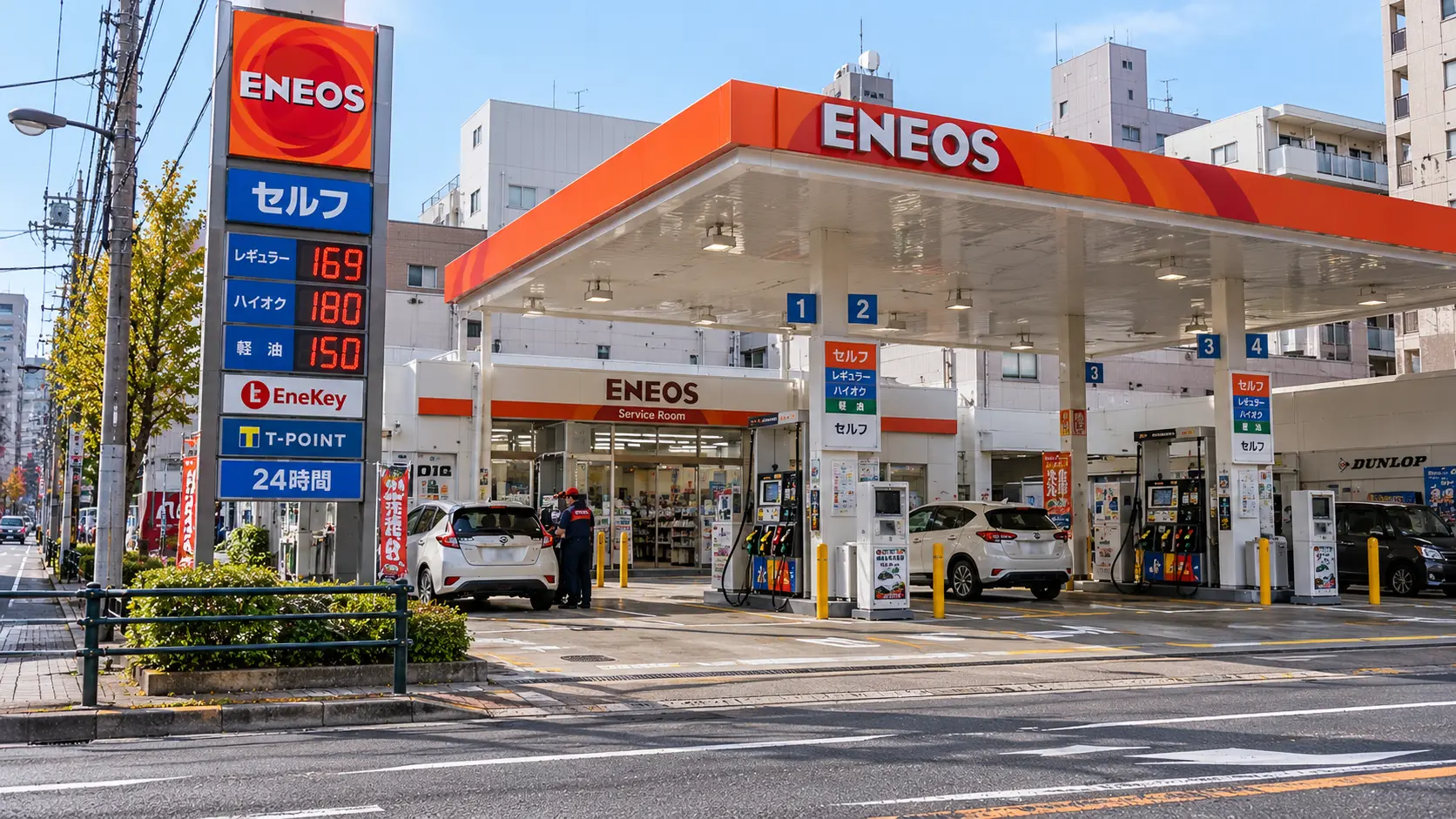
Self service (セルフ / Self Service)
These stations usually have 「セルフ」 (self) in eye-catching red or yellow lettering on the sign or at the top of the signboard. At a self-service station, you do everything yourself: tapping the screen, inserting cash or a card, touching the static-discharge pad, pumping the fuel, and collecting your change. The upside is that fuel is cheaper (usually 2 to 5 yen less per liter than full service) and opening hours are generally longer — many stations on major roads are even open 24 hours.
Full service (フルサービス / Full Service)
Full-service stations usually display 「フル」 on the sign, or simply have no 「セルフ」 marking. As you pull in, an attendant will stand beside the lane and loudly guide you to a spot. Roll down your window, tell the attendant which fuel and how much you want, and they’ll open the fuel cap and fill the tank for you. While you wait, the attendant will usually wipe your windshield and mirrors, and may even hand you a cloth or ask whether you have any small trash in the car to throw away (ゴミ, gomi). The service is attentive, but the price per liter is slightly higher, and outside urban areas most full-service stations close early (often between 19:00 and 20:00).
| Comparison | Self service (セルフ / Self) | Full service (フルサービス / Full) |
|---|---|---|
| Signage | Large 「セルフ」 or “SELF” lettering | Marked 「フル」 or no marking at all |
| Price per liter | Cheaper (saves about 2–5 yen per liter on average) | Higher (includes the cost of full attendant service) |
| How it works | The driver operates the touchscreen and the nozzle themselves | Staff handle everything and guide you into the bay |
| Extra services | None (use the station’s window cloths and water buckets yourself) | Staff wipe the windshield and mirrors and dispose of small trash from your car |
| Where you’ll find them | Expressway service areas (SA/PA), city ring roads, large chain stations | Narrow older city streets, remote rural areas, and mountain roads |
2. Know your nozzle colors and avoid a costly mistake: common Japanese gas station terms and fuel types
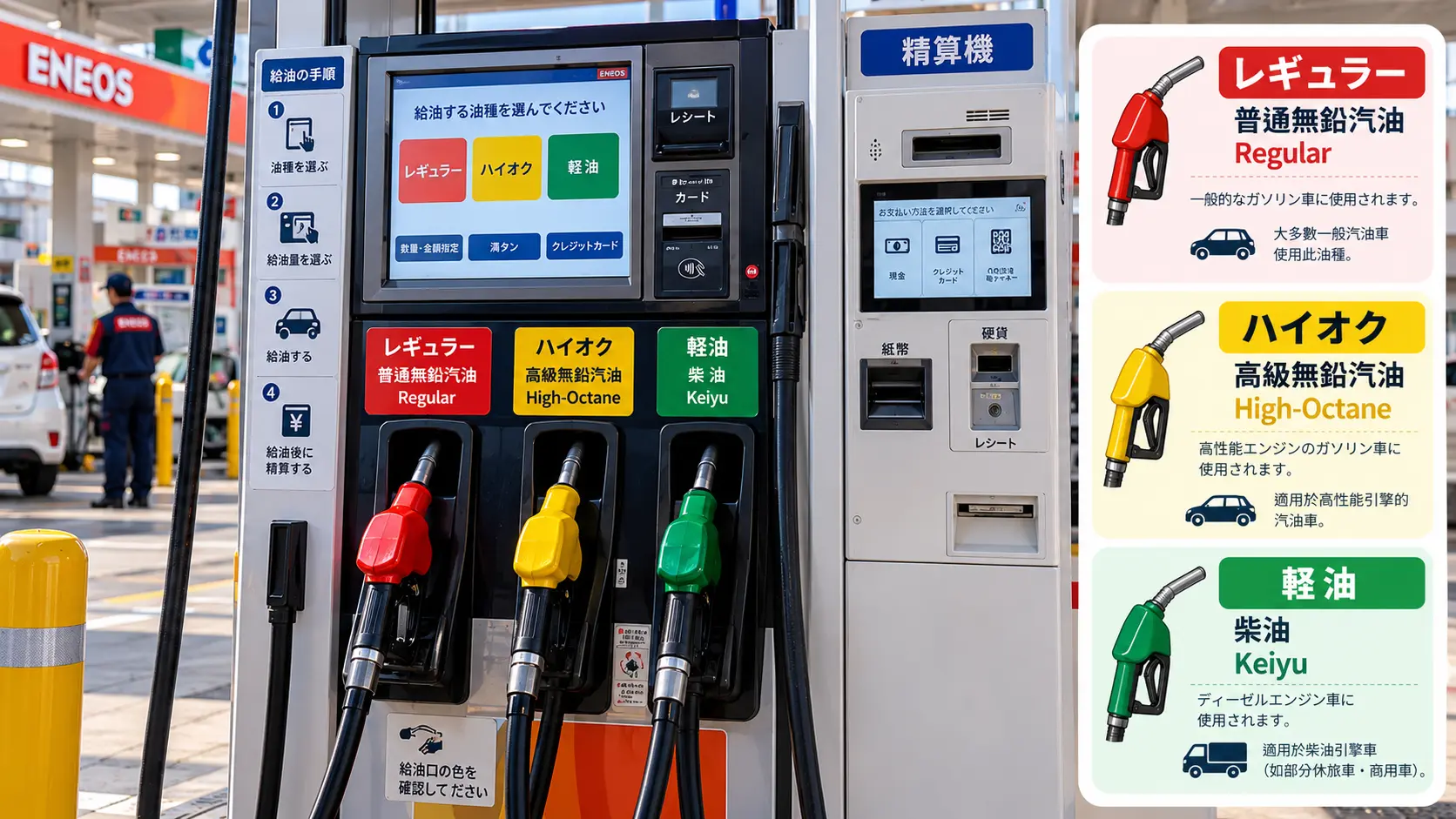
The single most important thing about refueling in Japan is never putting in the wrong fuel. To keep drivers from getting confused at self-service pumps, Japanese fire safety regulations require that nozzle handles and hoses at every self-service station in the country follow a standardized color code:
- Red nozzle (レギュラー / Regular): regular unleaded gasoline (octane rating around 90 or above, comparable to 92 or 95 unleaded in Taiwan). Almost all standard gasoline and hybrid cars from Japanese rental companies — such as the popular Toyota Yaris or Sienta — take red Regular gasoline.
- Yellow nozzle (ハイオク / High-Octane): premium unleaded gasoline (octane rating 98 or above, comparable to 98 unleaded in Taiwan). Mainly for luxury imports, high-performance sports cars, and a few models the manufacturer specifies it for.
- Green nozzle (軽油 (keiyu) / Diesel): diesel! Only for diesel-engine vehicles, such as large diesel SUVs, commercial trucks, and certain diesel vans.
The Japanese kanji 「軽油」 (keiyu, diesel) is definitely not fuel for light cars!
This is the most common serious mistake foreign visitors make when driving in Japan!
Many people see the Japanese kanji 「軽油(Keiyu)」 (diesel) and instinctively assume it’s the gasoline for Japan’s common “light cars” (kei cars, such as the 660cc models with yellow plates).
Remember this: in Japan, 「軽油」 (keiyu) means diesel! Kei cars are still gasoline cars at heart and must be filled with red Regular (レギュラー). If you put green diesel into a gasoline car, the engine will quickly build up carbon deposits, blow black smoke, stall, and may even destroy the entire fuel injection system and engine — leaving you with towing and major engine repair bills running into the hundreds of thousands of yen.
When you pick up the car, the required fuel type is clearly stated on the rental contract and on the key tag. If you’re unsure, you can also check the sticker on the inside of the fuel filler flap.
Handy Japanese phrases for gas stations in Japan
| Japanese (kanji / katakana) | Hiragana / romaji | Meaning in English | When you’ll use it |
|---|---|---|---|
| レギュラー | Regular | Regular unleaded gasoline (red nozzle) | Select on the screen or tell the attendant (the most common choice for rental cars) |
| ハイオク | High-Octane | Premium unleaded gasoline (yellow nozzle) | Used when fueling high-performance or imported models |
| 軽油 | けいゆ / Keiyu | Diesel (green nozzle) | For diesel vehicles only (never put it in a regular gasoline car or a kei car) |
| 満タン | まんたん / Mantan | Fill it up | Choose 「満タン」 (mantan, full tank) on the screen or tell the attendant |
| 現金 (genkin, cash) / クレジットカード | Genkin / Credit Card | Cash / credit card | Choosing your payment method |
| レシート / 領収書 (ryoshusho, receipt) | Receipt / Ryoshusho | Receipt / official receipt | Essential proof to show when returning the car |
| 精算 | せいさん / Seisan | Checkout / change | Collect your change at the change machine |
| オーライ | All right | Come on in, come on in (what attendants call out while guiding you) | Phrases attendants use at full-service stations when guiding your car into position |
The key phrase to memorize for full-service stations: 「レギュラー、満タンでお願いします。」
(Regular, mantan de onegaishimasu. / Fill it up with regular gasoline, please.)
3. How to pump your own gas in Japan: the 6 standard steps for beginners
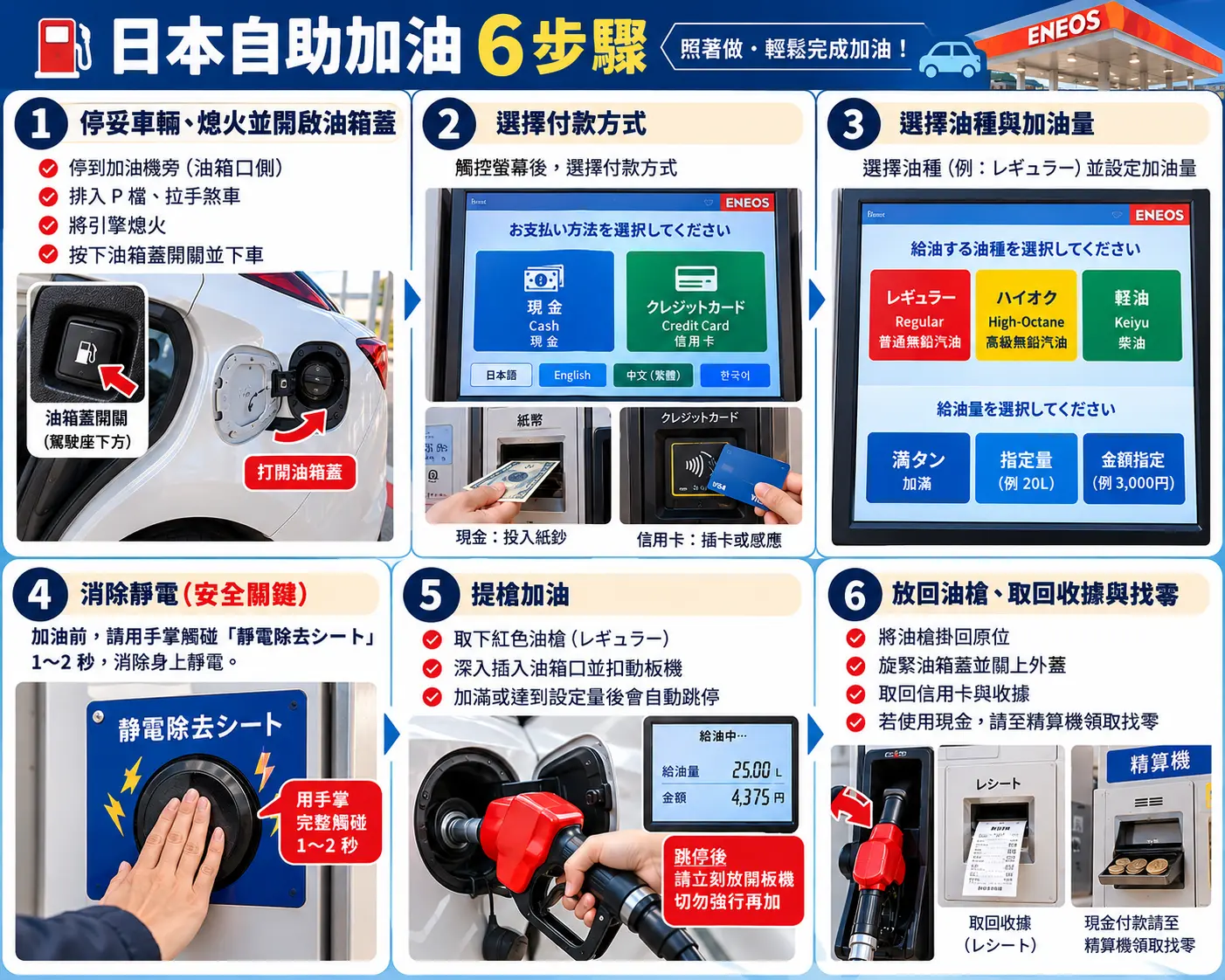
There’s no need to panic the first time you fill up on a self-drive trip in Japan. Japanese self-service pumps are designed to be foolproof and come with clear illustrations, so just follow these 6 standard steps:
- Step 1: Park the car, turn off the engine and open the fuel door
Line the fuel filler up with the pump and park, shift into P, pull the parking brake and switch the engine completely off. Pull the fuel door release under the driver’s seat, then get out and walk over to the pump.
- Step 2: Choose your payment method on the touchscreen
Touch the pump screen to start, and note that some newer machines let you switch to a Traditional Chinese or English interface. First choose your payment method, usually 「現金(Genkin)」 (cash) or 「クレジットカード」 (credit card).
If you’re paying cash, follow the on-screen prompt and insert bills totaling more than the fuel you expect to buy. If you’re paying by credit card, insert the card into the chip reader or tap it as instructed. - Step 3: Choose the fuel type and amount
The screen will show the fuel options; tap the red 「レギュラー(Regular)」.
Then choose how much to put in: if you’re about to return the car or drive a long distance, just tap 「満タン」 (fill it up). If you only want a set amount, you can specify the number of liters (for example 20L) or a yen amount (for example ¥3,000). - Step 4: Discharge static electricity (the safety step you must never skip)
Before you unscrew the fuel cap, look for the round black rubber pad beside the pump labeled 「静電気除去シート」 (static electricity removal pad).
Japan’s fall, winter and early spring air is dry, and the human body easily builds up static that can spark and ignite fuel vapor. Be sure to press your palm flat against the pad for 1 to 2 seconds to discharge the static and keep refueling safe. - Step 5: Insert the nozzle into the filler neck and squeeze the trigger
Unscrew the fuel cap and set it in the dedicated holder on the inside of the fuel door. Take the red nozzle, insert it deep into the filler neck, grip the handle and squeeze the trigger to start pumping.
The screen shows the liters and running total in real time. When the tank is full or you reach the amount you set, the sensor inside the nozzle clicks and shuts off automatically. At that point, release the trigger right away and don’t keep squeezing just to round the number off, or gasoline could overflow and create a hazard. - Step 6: Hang up the nozzle and collect your receipt and change
Hang the nozzle back on the pump, screw the fuel cap tight until you hear it click, then close the fuel door. Return to the screen to collect your credit card and receipt (レシート). If you paid cash and have change coming, check the coin slot on the pump or take the barcode slip to the change machine to get your money back.
4. Payment methods at Japanese gas stations and how to use the change machine
Paying at a Japanese gas station is very easy, and the following payment options are generally accepted:
Paying with an overseas credit card
Japanese pumps widely accept international credit cards such as Visa, Mastercard and JCB. After you insert the card, some machines may ask for a 4-digit PIN (usually your cash-advance PIN, or you can simply press the “confirm / green Enter key” on the screen or keypad to skip it). If an overseas credit card is occasionally declined (blocked by fraud-prevention systems), just switch to cash.
Paying with yen in cash and how the “change machine” works
Cash is the most reliable option on a self-drive trip. We suggest inserting a single ¥10,000 bill (the machine reads the amount first and only deducts what you actually pump).
Please note: many self-service pumps in Japan “do not dispense change themselves.” After you finish pumping, the machine prints a change slip with a barcode or QR code.
Take that slip to the 「精算機」 (automatic change machine) next to the station office or at the edge of the pump island, hold the barcode up to the scanner, and the machine will automatically return your coins and bills. Just remember not to drive off right after refueling, or you’ll forget to pick up your change!
IC cards and mobile payments
Some chains (such as ENEOS) accept transit IC cards (Suica, ICOCA) as well as mobile payments like Apple Pay and PayPay. Because overseas travelers’ phone setups and account restrictions vary, though, the safest bet is to carry 1 or 2 physical credit cards and enough yen in cash.
5. Which gas station brands are there in Japan? Price differences and chain features
As you drive Japan’s roads, you’ll see these three major gas station brands again and again:
- ENEOS: the market leader in Japan, easily spotted by its orange-red swirl logo. With locations across cities, expressways and remote countryside, it’s the chain you’ll find most easily on long self-drive trips.
- apollostation (Idemitsu Kosan / Showa Shell): a modern blue, white and red sign; formed by the merger of Idemitsu Kosan and Showa Shell, with a very large number of locations.
- Cosmo Oil: identified by purple and white, often with large self-service flagship stations offering car washes and well-equipped facilities.
As for fuel quality, every licensed gas station in Japan strictly follows the Act on the Quality Control of Gasoline and Other Fuels, so gasoline purity and combustion efficiency are identical across the major brands; none is better or worse than another.
Price differences between brands amount to only a few yen per liter (mostly from member discount campaigns), so there’s no need to shop around for a particular brand. Just pull into whichever major-brand station is on your route and easy to get in and out of.
6. How to find a nearby gas station: navigation searches and fuel price tools
Knowing where the gas stations are ahead of time keeps you from panicking on an empty tank, especially in rural or mountainous areas where the sights are far apart:
Tips for searching on the car’s GPS navigation
If you type the Chinese word for gas station into a Japanese car navigation system, you’ll usually get no results. When searching nearby facilities, choose the Japanese category 「ガソリンスタンド」 (gasoline stand) or the abbreviation “GS,” or simply enter a brand name such as “ENEOS” to search the surrounding area.
Searching on Google Maps and checking opening hours
Search “Gas Station” on Google Maps, or tap the gas station shortcut icon at the top of the map. When driving in the countryside or the mountains (such as eastern Hokkaido, the Tohoku region or the mountains of Nagano), be sure to double-check opening hours. Outside the big cities, many Japanese gas stations close as early as 18:00 to 19:00, and some are closed all day on Sundays. On remote stretches, fill up as soon as your tank drops below half.
Tools for checking current fuel prices in Japan
To see how average fuel prices are trending in each prefecture, check Japan’s well-known fuel price community sites gogo.gs and e-nenpi. Prices vary by region depending on transport distance and local competition: inland mountainous areas (such as Nagano and Yamagata) and some remote islands are usually a little pricier than cities on Honshu, so planning your fuel budget helps you estimate trip costs more accurately.
7. The full-tank return rule (満タン返し) and keeping your fuel receipt
When your self-drive adventure wraps up and it’s time to hand the car back, the most important rule is “return it with a full tank” (満タン返し / Mantan Gaeshi). Under the standard contracts of all the major rental companies, the tank is full when you pick the car up, and it must be full again when you return it.
How close to the branch you have to fill up
Rental companies usually state it clearly: you must fill the tank at a gas station within 5 kilometers of the return branch (or within a 10 to 15 minute drive). If you fill up dozens of kilometers away, the gauge may have dipped slightly by the time you arrive, and the tank will be treated as not full.
Keeping the fuel receipt (レシート) is mandatory
Never toss out the printed receipt you get after filling up! At return, besides checking the car’s condition and whether the gauge reads full, the first thing the staff will do is ask to see your most recent fuel receipt (レシート). They’ll carefully check 3 key details on it:
- Time of purchase: was it within 1 to 2 hours before the return?
- Station address and name: was it a station within the specified area?
- Fuel type and liters: confirming you used the specified fuel (for example, Regular from the red nozzle) and filled the tank.
If you can’t produce the receipt, the rental company still has the right, even with the gauge showing full, to charge you a fuel fee based on the distance driven at their official rate (usually 20% to 50% higher per liter than market price).
8. FAQ: refueling on a self-drive trip in Japan
There are three common ways to open it:
1. A lever on the driver’s floor: Japanese cars are right-hand drive, so the release is usually on the floor to the lower right of the driver’s seat (near the right door sill), typically marked with a fuel pump icon; pull it up and the door pops open.
2. A button below the dashboard: on the control panel to the lower right of the steering wheel; press the button with the fuel pump icon.
3. Push the door itself: on some European models and newer Japanese cars (such as certain Nissan or Toyota models), you can simply press the edge of the fuel door by hand while the car is unlocked and it pops open.
Just look at the fuel gauge on the dashboard: next to the pump icon there’s a small triangular arrow (◀ or ▶).
If the arrow points left (◀), the fuel door is on the left side of the car; if it points right (▶), it’s on the right. Just pull into the lane on the side the arrow indicates.
Do not start the engine! If you start it after misfueling, the diesel will quickly reach the fuel lines and injectors and cause serious damage to the engine and fuel system. Keep the engine completely off, ask the station staff to help push the car to a safe open area, and contact the rental company and roadside assistance immediately.
[Important insurance note] Misfueling counts as gross negligence and improper use, and every rental company in Japan excludes “using the wrong fuel” from its insurance (including the CDW compensation system and NOC coverage)! Draining and flushing the tank, engine repairs, towing and the NOC loss-of-income charge while the car is out of service all come out of your own pocket, so double- and triple-check the correct fuel type before you pick up the nozzle.
If you pull in late at night and no staff are around, just follow the prompts on the screen. Note that some nighttime machines, as an anti-theft measure, may only accept credit cards or electronic payment and refuse cash, so it’s best to have a physical credit card ready when refueling after dark.
This article was translated by AI from the original Chinese version.